

The role of LCD screen handling manipulators in modern manufacturing has evolved from basic material transport to becoming critical components of high-precision, cleanroom-ready automation. In 2026, these systems are essential for maintaining the yield and quality of increasingly large, thin, and complex display panels.
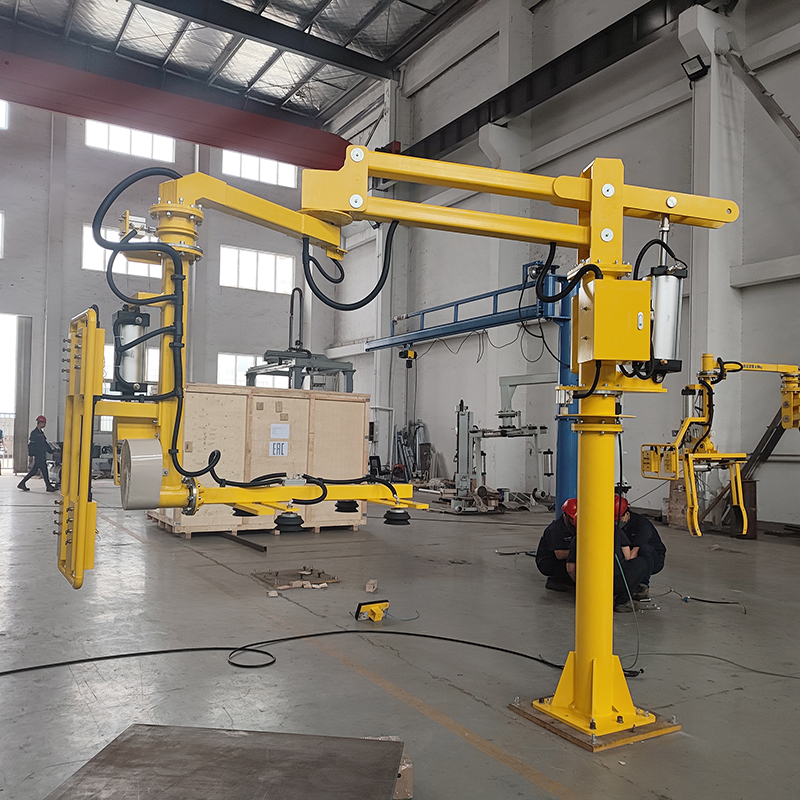
1. The Critical Need for Specialized Handling
LCD screens are characterized by high fragility, susceptibility to stress-induced defects (such as mura or cell-gap distortion), and sensitivity to electrostatic discharge (ESD). Unlike metallic or rigid industrial parts, an LCD screen is essentially a delicate “sandwich” of glass, liquid crystal, and thin-film transistors (TFTs).
Manual handling is prone to human error, which risks surface marring, accidental impacts, or contamination. Automated manipulators address these challenges by providing:
-
Uniform Force Distribution: By utilizing distributed vacuum arrays or non-contact Bernoulli grippers, manipulators ensure that lifting force is spread across the panel, preventing localized stress that could lead to micro-fractures.
-
Vibration Damping: LCD screens are prone to oscillation during rapid movement. Modern manipulators integrate advanced motion-profile algorithms to perform “soft-start” and “soft-stop” movements, preventing the screen from whipping or vibrating upon arrival at an assembly fixture.
2. Enhancing Productivity
Modern manufacturing lines require high-speed, 24/7 reliability. LCD handling manipulators enhance productivity by:
-
Maximizing Cleanroom Uptime: Because these manipulators are designed with sealed, particle-free joints and cleanroom-compatible materials, they can operate continuously without the contamination risks associated with human personnel donning and doffing protective gear.
-
Autonomous Workflow Integration: Modern systems are increasingly integrated with MES (Manufacturing Execution Systems) and vision-guided pathing. They can automatically identify a screen’s orientation, adjust their grip, and align the panel with a bezel or chassis in seconds, drastically reducing cycle times compared to manual alignment.
-
Eliminating Bottlenecks: By automating the transport of screens between staging, testing, and assembly stations, these systems prevent the production line bottlenecks common in manual processes.
3. Precision and Quality Control
Precision in LCD assembly is measured in sub-millimeter tolerances. Manipulators contribute to this precision in several ways:
-
Vision-Guided Alignment: Integrated high-resolution cameras allow the manipulator to perform “active correction.” Before the final placement, the robot detects the screen’s edge coordinates and calculates the precise offset needed to ensure a perfect fit into the device housing.
-
Real-time Feedback: Many modern manipulators include force-feedback sensors. If a screen encounters resistance while being inserted into a bezel, the system can instantly halt motion and alert the controller, preventing the panel from being crushed.
-
Traceability: Modern robotic grippers often include integrated barcode or QR scanners. This ensures that the exact screen serial number is logged at the moment of handling, providing a full digital footprint for quality assurance and warranty tracking.
4. Trends Shaping 2026 Manufacturing
-
Physical AI and Autonomous Decision-Making: Moving beyond rigid, fixed-rule programming, current manipulators use “Physical AI” to understand their environment. They can adapt their movement paths in real-time if a tray is slightly misaligned, reducing the need for constant mechanical calibration.
-
Modular Cleanroom Design: Manipulators are increasingly part of modular, self-contained cleanroom cells that can be reconfigured as product designs change, ensuring that manufacturers can pivot quickly between different screen sizes or device types.
-
Smart Power Management: As manufacturers prioritize energy efficiency, newer manipulators feature intelligent energy recovery systems and optimized motion pathing to minimize electricity consumption without sacrificing cycle speed.
By automating the most delicate part of the electronics assembly process, LCD handling manipulators transform manufacturing from a high-risk manual task into a repeatable, scalable, and highly accurate automated flow.
Post time: May-27-2026