

Palletizing is an important step at the end of many manufacturing and packaging processes. Bags, cartons, boxes, rolls, containers, and other products need to be transferred from a production or packaging line and arranged onto pallets before storage or shipment.
When this work is performed manually, operators may need to repeatedly lift, rotate, position, and stack products throughout an entire shift. As production volumes increase, manual palletizing can become a limitation for both productivity and workplace ergonomics.
Modern palletizing equipment provides a way to improve this process while maintaining the flexibility required by different products and production environments.
Rather than selecting equipment based only on lifting capacity, manufacturers should consider the complete palletizing process, including the product characteristics, gripping method, pallet pattern, working range, cycle requirements, and factory layout.
What Is Palletizing Equipment?
Palletizing equipment refers to machinery used to automatically or semi-automatically pick up products and arrange them onto pallets according to a predefined stacking pattern.
A palletizing system may include a manipulator, robotic arm, conveyor, end-of-arm tooling, pallet positioning device, sensors, and control system.
Depending on the application, the equipment can perform several operations:
- Product picking
- Lifting and lowering
- Horizontal transfer
- Product rotation
- Layer positioning
- Pallet stacking
- Pallet transfer
- Loading and unloading
The configuration should be matched to the physical characteristics of the product and the required production process.
For some applications, a conventional robotic palletizer may be appropriate. For other applications involving heavy, irregular, delicate, or oversized products, a specialized palletizing manipulator can provide a more suitable solution.
Why Is Palletizing Automation Important?
Palletizing is repetitive by nature. A production line may continuously deliver products that must be positioned onto pallets in the same sequence.
Although the basic movement appears simple, the combination of lifting, positioning, rotation, and stacking can create significant physical demands when performed manually.
Reduce Repetitive Manual Lifting
Automated or assisted palletizing equipment can take over repetitive lifting and transfer operations.
This allows operators to focus more on production supervision, quality inspection, material replenishment, and other activities instead of repeatedly moving heavy products.
Improve Stacking Consistency
Consistent product positioning is important for pallet stability.
A controlled handling system can place products according to a predefined stacking pattern, helping manufacturers achieve more repeatable pallet configurations.
Handle Heavy or Awkward Products
Some products are difficult to handle with standard robotic grippers.
Heavy bags, large cartons, rolls, irregular components, and other products may require customized gripping or supporting mechanisms.
A manipulator-based palletizing solution can be configured with application-specific tooling to accommodate these requirements.
Different Types of Palletizing Equipment
There is no single palletizing machine suitable for every production line.
The best configuration depends on the product and the required movement.
Robotic Palletizing Equipment
Robotic palletizing systems use industrial robots to pick products and arrange them on pallets.
They are commonly considered for applications requiring repeatable movements, relatively high production rates, and programmable pallet patterns.
The robot can be equipped with different end effectors according to the product being handled.
Palletizing Manipulators
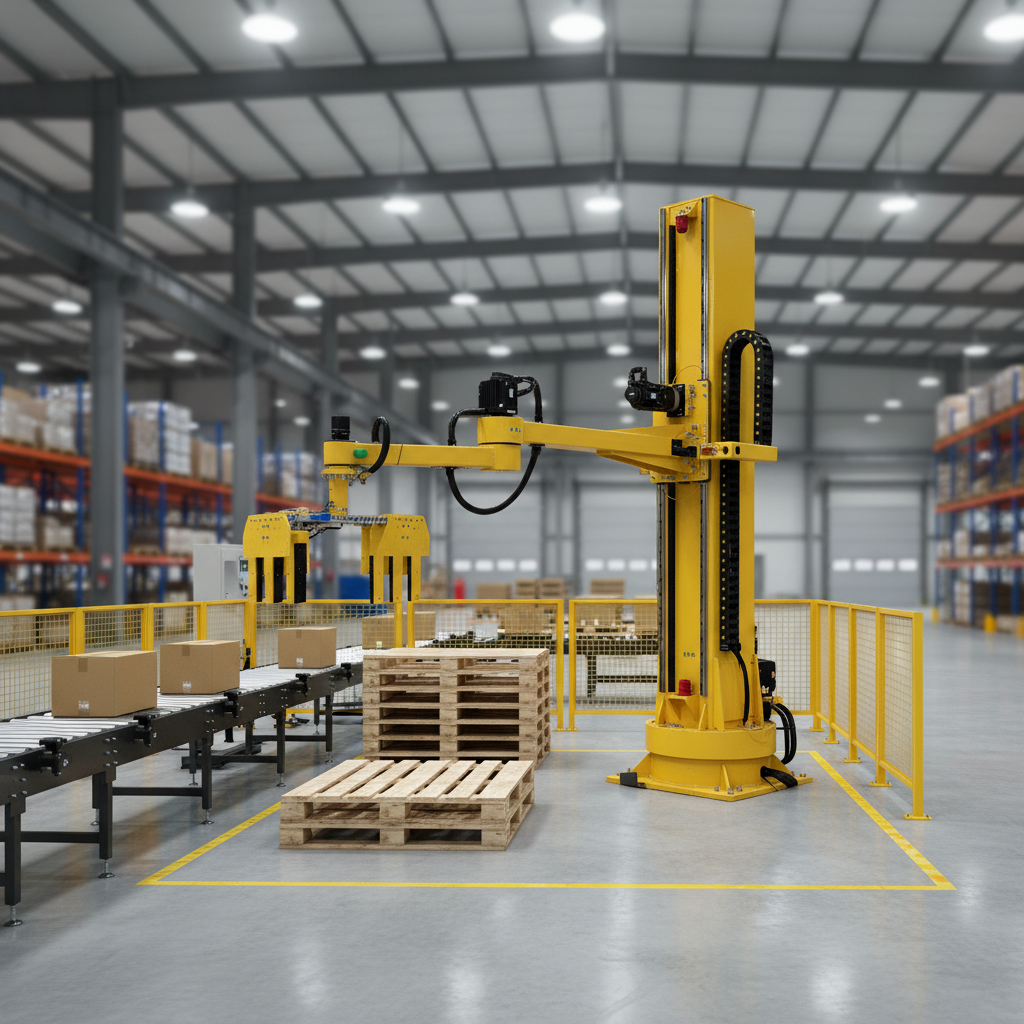
A palletizing manipulator uses a mechanical arm or assisted handling structure to lift and position products.
This approach is particularly useful when operators still need to interact directly with the product while receiving mechanical lifting assistance.
Tongli’s power-assisted manipulators are designed with rigid arms and can be configured for operations where workpieces need to be overturned, stacked, loaded, or unloaded.
This makes a manipulator-based solution useful for applications where flexibility and operator control are important.
Gantry Palletizing Equipment
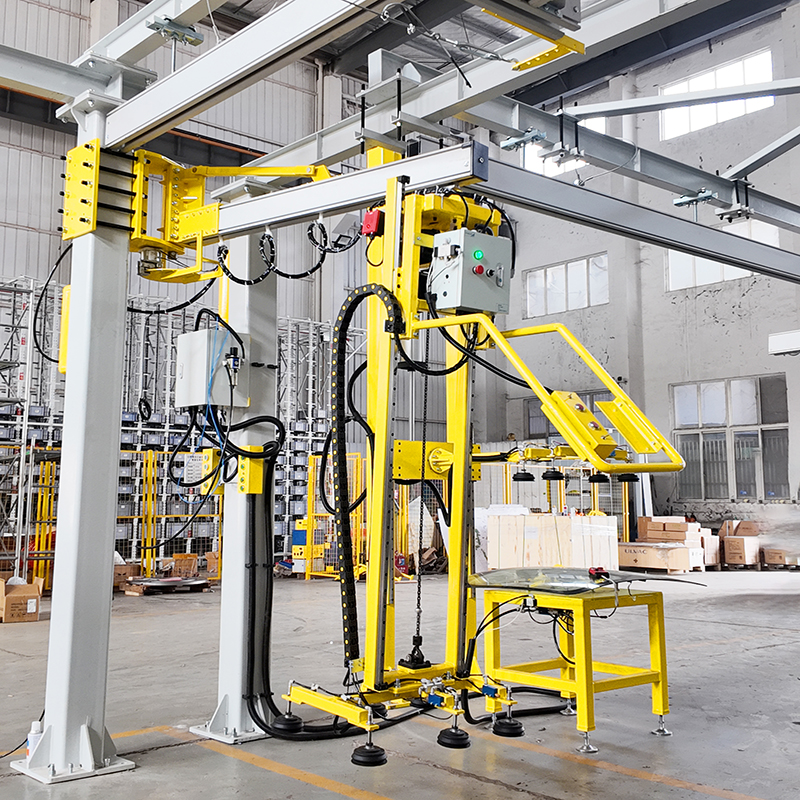
A gantry or truss manipulator moves along a defined overhead structure.
This configuration can provide a large working area and can potentially serve multiple stations. According to the current Tongli product information, its gantry power-assisted manipulator is suspended below a track fixed to a truss and can serve multiple workstations.
Gantry systems can therefore be considered when palletizing or material transfer needs to cover a relatively large production area.
Vacuum Palletizing Equipment
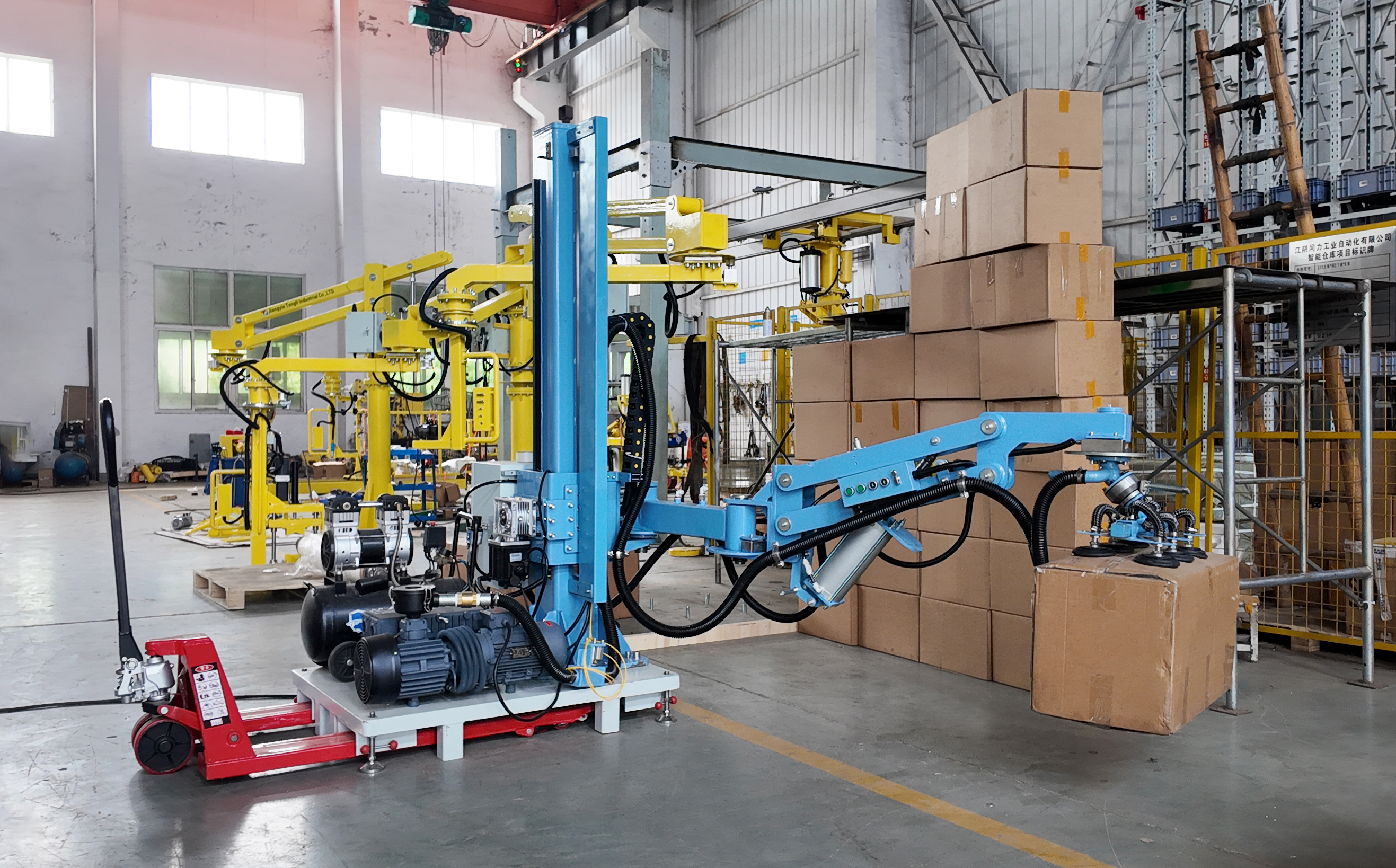
Vacuum technology can be used when the product surface is suitable for suction.
Vacuum tube lifters and vacuum manipulators are already part of Tongli’s material handling portfolio. The company describes vacuum tube lifters as suitable for repetitive handling of products such as bags, cardboard boxes, windows, doors, and other materials.
For suitable products, vacuum handling can provide fast gripping and release without requiring mechanical clamps around the product.
How to Select the Right Palletizing Equipment
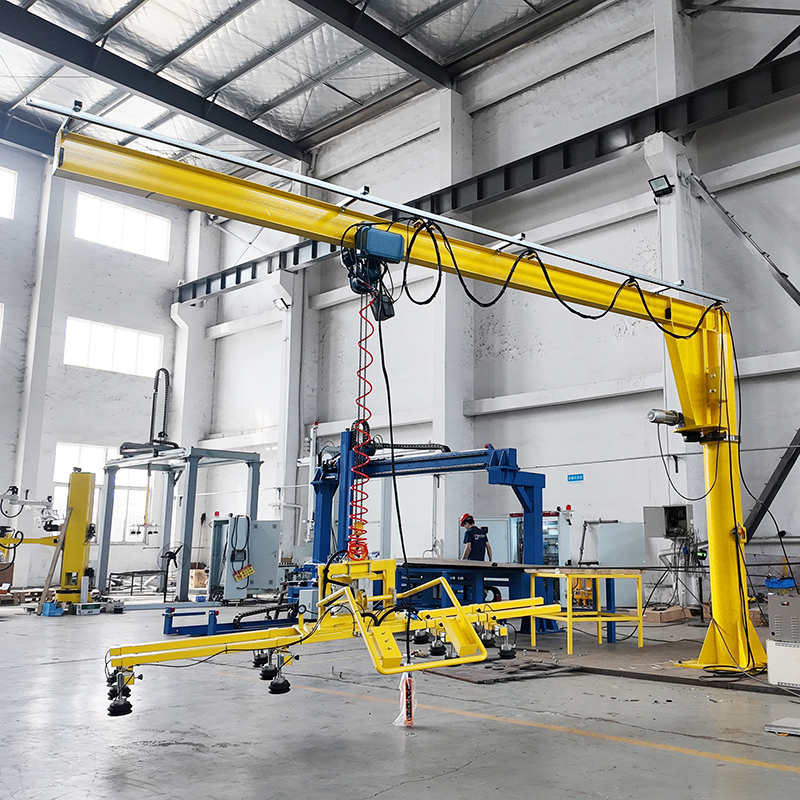
Choosing palletizing equipment should begin with the product rather than the machine.
1. Product Weight
The first parameter is the actual handling weight.
The calculation should include not only the product itself but also the gripping device or tooling attached to the equipment.
For heavier products, the required manipulator structure, actuator, support system, and safety configuration may be different from those used for lightweight cartons.
2. Product Dimensions
Product dimensions influence both the gripping method and the required working range.
Large products may require multiple suction cups or a larger mechanical fixture, while small products may be handled using a compact gripper.
The product’s center of gravity should also be considered when rotation or tilting is required.
3. Product Surface
The surface condition can determine whether vacuum handling is appropriate.
Smooth, relatively non-porous surfaces may work well with suction-based tooling, while porous or irregular products may require another gripping method.
Tongli’s vacuum handling products include configurations for boxes, bags, sheet materials, and other products, demonstrating why the end effector should be selected according to the actual material.
4. Pallet Pattern
The required pallet arrangement is another important consideration.
Products may need to be arranged in:
- Block patterns
- Interlocking patterns
- Column patterns
- Alternating layers
- Custom stacking configurations
The equipment needs sufficient movement flexibility to achieve the required pattern without interfering with adjacent products or pallet structures.
5. Cycle Time
Production speed determines how quickly the equipment must complete each pick-and-place cycle.
If the production line continuously produces products at a high rate, the palletizing system needs to match the upstream production speed.
Cycle time should therefore be evaluated together with product weight, movement distance, gripping method, and pallet pattern.
The Importance of End-of-Arm Tooling
The gripping device is one of the most important parts of palletizing equipment.
A technically capable manipulator cannot perform reliable palletizing if the end effector is poorly matched to the product.
Different applications may use:
Mechanical clamps
Suitable for products that can be securely gripped from the sides or specific structural points.
Vacuum suction tools
Useful for products with suitable surfaces, including certain cartons, sheets, panels, and other packaged materials.
Hooks and specialized fixtures
Appropriate for products with dedicated lifting points or unusual geometries.
Customized grippers
Designed for products that cannot be reliably handled using standard tooling.
Tongli’s product portfolio includes fixture manipulators, vacuum sucker manipulators, air shaft manipulators, and customized gripper-assisted manipulator arms.
This modular tooling approach allows palletizing equipment to be adapted to different production requirements.
Palletizing Equipment for Roll Products
Roll handling is a specialized application that requires additional attention to product geometry and stability.
Film rolls, paper rolls, foil rolls, and other cylindrical products cannot always be handled effectively with standard carton palletizing equipment.
A roll may need to be rotated, aligned, transferred, and positioned horizontally or vertically before being placed on the pallet.
Tongli currently offers a Roll Film Palletizing Manipulator, while its broader product portfolio also includes film roll lifting and handling solutions.
For these applications, the manipulator and tooling should be designed around the roll diameter, width, weight, surface characteristics, core structure, and required pallet arrangement.
Palletizing Equipment for Bags and Cartons
Bags and cartons are common palletizing products, but they have very different handling characteristics.
Cartons generally provide relatively stable surfaces for vacuum suction or mechanical gripping.
Bags can be more flexible and may have changing shapes or centers of gravity. Vacuum tube technology can be particularly useful for suitable bag-handling applications.
Tongli’s vacuum lifter solutions describe applications involving bagged goods and cartons, while specialized bag lifters are designed around different bag materials and surface characteristics.
Therefore, the equipment should be selected according to the actual packaging material instead of assuming that one gripper can handle every product.
Integrating Palletizing Equipment Into a Production Line
Palletizing equipment is most effective when it is considered as part of the complete material flow.
A typical production process may include:
Production → Conveying → Product Detection → Positioning → Picking → Palletizing → Pallet Transfer → Storage
The palletizing equipment may receive products directly from a conveyor, identify their position, pick them using the appropriate tooling, and place them according to the programmed pallet pattern.
Additional equipment can be integrated when necessary, such as pallet dispensers, pallet conveyors, product accumulation conveyors, safety systems, and automatic pallet transfer equipment.
This approach allows the palletizing operation to become part of a connected production and logistics process rather than an isolated machine.
When Should You Consider Customized Palletizing Equipment?
Standard palletizing equipment can work well when products and production conditions are relatively consistent.
Customized equipment becomes more valuable when the application involves:
- Irregular product shapes
- Heavy workpieces
- Multiple product sizes
- Multiple pallet formats
- Limited installation space
- Long transfer distances
- Product rotation or tilting
- Multiple production stations
- Special gripping requirements
- Integration with existing machinery
In these situations, a customized manipulator can be designed around the actual production process.
The objective is not simply to automate the lifting movement, but to create a reliable handling process from product pickup to final pallet placement.
Conclusion
Palletizing equipment plays an important role in modern industrial material handling.
The right solution depends on much more than lifting capacity. Product weight, dimensions, surface characteristics, pallet pattern, cycle time, working range, tooling, and factory layout all influence the final equipment configuration.
For standard cartons and packaged products, robotic or vacuum-based palletizing may provide an efficient solution. For heavy, irregular, oversized, or specialized products, a customized palletizing manipulator can offer greater flexibility.
By combining the appropriate manipulator structure with application-specific end-of-arm tooling, manufacturers can create palletizing processes that are more consistent, ergonomic, and adaptable to changing production requirements.
Post time: Oct-08-2026