

In modern industrial manufacturing, maximizing shop floor efficiency is no longer just a metric—it is a competitive necessity. As automotive assembly lines, heavy equipment plants, and material handling facilities strive for leaner operations, traditional bulky overhead gantry systems often fall short. They are rigid, require massive structural footprints, and create operational bottlenecks.
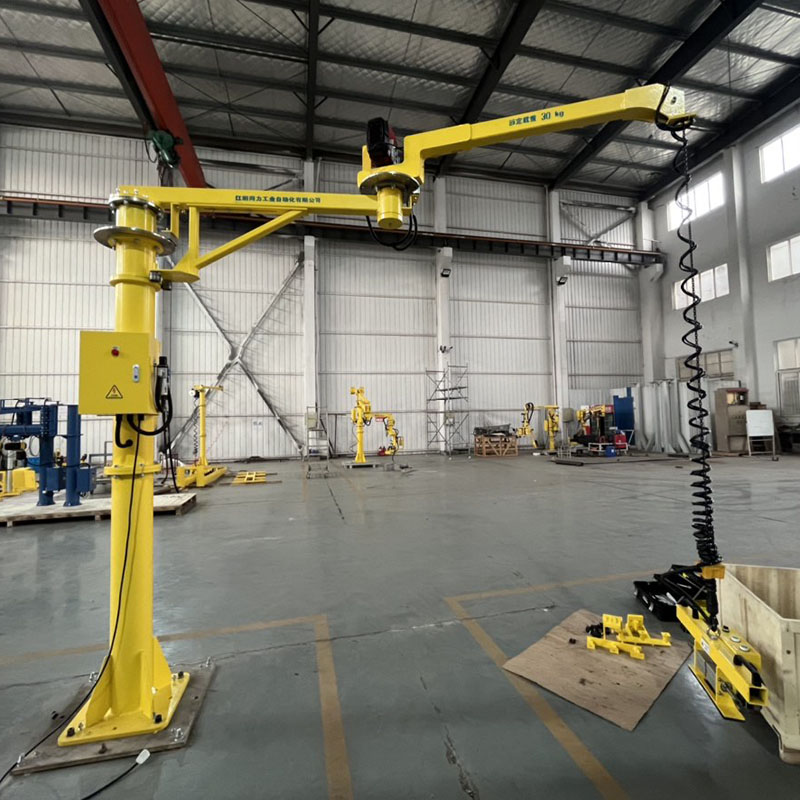
Enter the folding boom crane (also commonly referred to as an articulating jib crane).
Engineered with a unique dual-jointed design, these manipulators provide unprecedented spatial flexibility and precise positioning for high-cycle, heavy-duty material handling.
What is a Folding Boom Crane?
Unlike standard rigid-arm jib cranes that move strictly in a single radius, a folding boom crane utilizes a secondary articulating joint. This mimicry of human arm movement allows the crane to “fold” back on itself or reach around structural obstacles like support pillars, welding booths, or overhead ductwork.
When paired with advanced pneumatic or hydraulic lifting systems, these cranes transform from simple lifting hooks into highly precise, zero-gravity industrial manipulators. For operations requiring custom handling solutions, utilizing a specialized folding boom crane ensures that non-standard workpieces—such as automotive chassis components, engines, or heavy stamping dies—can be lifted and rotated seamlessly.
Key Advantages for B2B Industrial Operations
1 Zero Dead-Zone Maneuverability
Traditional jib cranes have a “dead zone” close to the pillar where the hoist cannot effectively position a load. An articulating or folding arm completely eliminates this issue. The inner and outer boom sections move independently, allowing the operator to maneuver the hook or custom gripper directly next to the mounting mast.
2 Effortless Ergonomics and Speed
High-frequency assembly lines require fast cycle times without sacrificing worker safety. Equipped with pneumatic balancing technology, folding boom cranes neutralize the weight of the payload. The operator experiences near-zero resistance, dramatically reducing repetitive strain injuries (RSIs) while accelerating throughput.
3 Compact Footprint and Clear Overhead
Because the arm can fold neatly out of the way when not in use, these cranes free up vital overhead space for forklift paths, AGVs (Automated Guided Vehicles), or larger facility cranes. They can be floor-mounted, wall-bracketed, or ceiling-suspended depending on your specific factory layout.
Technical Specifications to Consider
When sourcing an industrial articulating manipulator for your facility, engineers should evaluate several critical parameters to ensure optimal integration:
-
Load Capacity: Standard pneumatic models typically handle payloads ranging from 50 kg to 500 kg, while heavy-duty hydraulic variants can support significantly more.
-
Working Radius: The combined length of the primary and secondary arms dictates the total reach—typically ranging from 2 to 5 meters.
-
Rotation Angles: Look for systems offering 360-degree continuous rotation at the primary pillar joint and up to 300 degrees of articulation at the secondary joint for maximum coverage.
-
End-Effectors (Grippers): The crane is only as good as its interface with the part. Ensure your provider can design custom mechanical, vacuum suction, or pneumatic clamp end-effectors tailored to your specific workpiece.
Industrial Applications
Folding boom cranes excel in environments where precision and spatial constraints intersect:
Automotive Assembly: Perfect for reaching inside vehicle cabins to install seats, manipulation of heavy tires, or precise positioning of windshields.
Machining Centers: Ideal for loading and unloading heavy raw castings or stamping parts into CNC machines with tight enclosures.
Warehousing and Depalletizing: Streamlines the rapid handling of heavy bags, drums, or boxes in tight racking aisles.
Conclusion: Partnering for Custom Integration
Every factory floor presents a unique puzzle of spatial constraints and technical requirements. Off-the-shelf lifting equipment rarely solves the complex demands of modern industrial automation. To truly optimize your workflow, investing in custom-engineered material handling technology is paramount.
Discover how a tailored articulating system can transform your production efficiency by exploring the engineering capabilities at TL Manipulator.
Post time: Jul-06-2026