

In today’s fast-paced industrial manufacturing landscape, factories face a dual challenge: increasing throughput while ensuring strict compliance with workplace safety and ergonomic standards. Heavy lifting, repetitive manual handling, and complex assembly tasks often lead to operator fatigue, costly product damage, and increased musculoskeletal disorders (MSDs).
To bridge the gap between human dexterity and mechanical power, global manufacturers are increasingly adopting pneumatic assist systems (also known as pneumatic balancing manipulators). These specialized material handling solutions leverage compressed air technology to neutralize the weight of heavy loads, transforming demanding physical labor into seamless, effortless human-machine collaboration.
What is a Pneumatic Assist System?
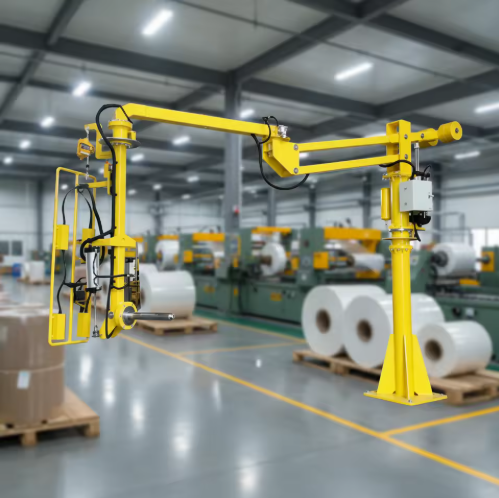
A pneumatic assist system is an ergonomic lifting device that uses regulated air pressure to achieve a state of “zero-gravity” suspension. By continuously balancing the downward force of gravity against the upward force of a pneumatic cylinder, the system allows an operator to lift, lower, tilt, and rotate heavy or awkward workpieces with minimal physical exertion.
Unlike traditional electric hoists or overhead cranes, which rely on rigid button-controlled up-and-down speeds, pneumatic systems respond dynamically to the operator’s manual touch. The system senses the load and weightlessly floats it in mid-air, acting as a direct extension of the worker’s arm.
Key Business Benefits of Pneumatic Balancing Technology
Implementing industrial pneumatic manipulators within your production line provides measurable returns on investment (ROI) across three primary metrics: safety, quality, and throughput.
-
Elimination of Workplace Injuries: Repetitive manual lifting of items over 15 kg is a leading cause of industrial worker compensation claims. Pneumatic systems absorb 100% of the load weight, dramatically reducing worker fatigue and spine-related strains.
-
Enhanced Assembly Precision: Cable-based hoists are prone to swaying and uncontrolled rotation. Rigid-arm pneumatic manipulators eliminate sway, providing the structural stability required for micro-level alignment, precise shaft-to-hole insertion, and delicate component fitting.
-
Sustained Operational Throughput: Human operators inevitably slow down during the middle and end of a shift due to physical exhaustion. Zero-gravity systems allow operators to maintain a consistent, fast-paced cycle time from hour one to hour eight.
-
Damage-Free Product Handling: Equipped with customized end-effectors—such as vacuum suction arrays, pneumatic clamps, or expanding mandrels—these systems grip materials securely without marring, scratching, or denting high-value surfaces.
Core Industrial Applications
The versatility of pneumatic assist systems makes them indispensable across a wide variety of sector-specific workflows:
1. Automotive Assembly Lines
The automotive sector demands high-frequency precision. Pneumatic manipulators are heavily relied upon in total assembly workshops for handling complex parts:
-
Windshield & Glass Installation: Utilizing specialized suction cups to gently lift large windshields and position them accurately onto the vehicle frame.
-
Tire and Wheel Mounting: Lifting heavy assemblies and aligning bolt holes with zero stud damage.
-
Powertrain Component Fitting: Maneuvering heavy engine blocks, transmissions, and battery PACK modules smoothly into the vehicle chassis.
2. Logistics, Warehousing, and Palletizing
In high-volume distribution centers, rapid sorting and box stacking can cause severe operational bottlenecks.
-
Carton & Box Handling: High-frequency pneumatic vacuum tube lifters allow a single operator to rapidly pick up, rotate, and palletize heavy boxes from conveyor belts with a single-handed control interface.
-
Container Loading & Unloading: Mobile pneumatic configurations can be deployed directly into tight container spaces to accelerate inbound and outbound shipping logistics.
3. Heavy Metal and Foundry Handling
Handling heavy raw materials, metal sheets, and casting sandboxes presents significant physical risks to workers. Pneumatic systems equipped with high-load rigid arms can safely pick up large steel sheets for laser cutting machine continuous feeding or lift heavy foundry sandboxes away from hazardous heat zones.
Selecting the Right Structural Configuration
Pneumatic assist systems are highly modular and must be tailored to your specific workshop layout, ceiling height, and floor-space availability. The three most common configurations include:
| Configuration Type | Best For | Structural Characteristic |
| Fixed Floor Pedestal | Dedicated, stationary work cells (e.g., specific machine tool loading). | Bolted directly to the floor; offers a stable 360-degree radial working area. |
| Overhead KBK Rail / Gantry | Large-span workspaces covering multiple consecutive workstations. | Suspended from overhead steel frameworks; preserves valuable floor space. |
| Mobile Base Unit | Flexible factories with fluctuating production lines or multiple pick points. | Integrated onto a counterweighted platform that can be easily relocated via forklift or pallet jack. |
Post time: Jun-22-2026