

Handling large and heavy panels manually can be difficult, especially when materials are oversized, smooth, fragile, or frequently moved during production. An industrial vacuum lifter provides a practical solution by using vacuum suction technology to grip and transport panels with less manual effort.
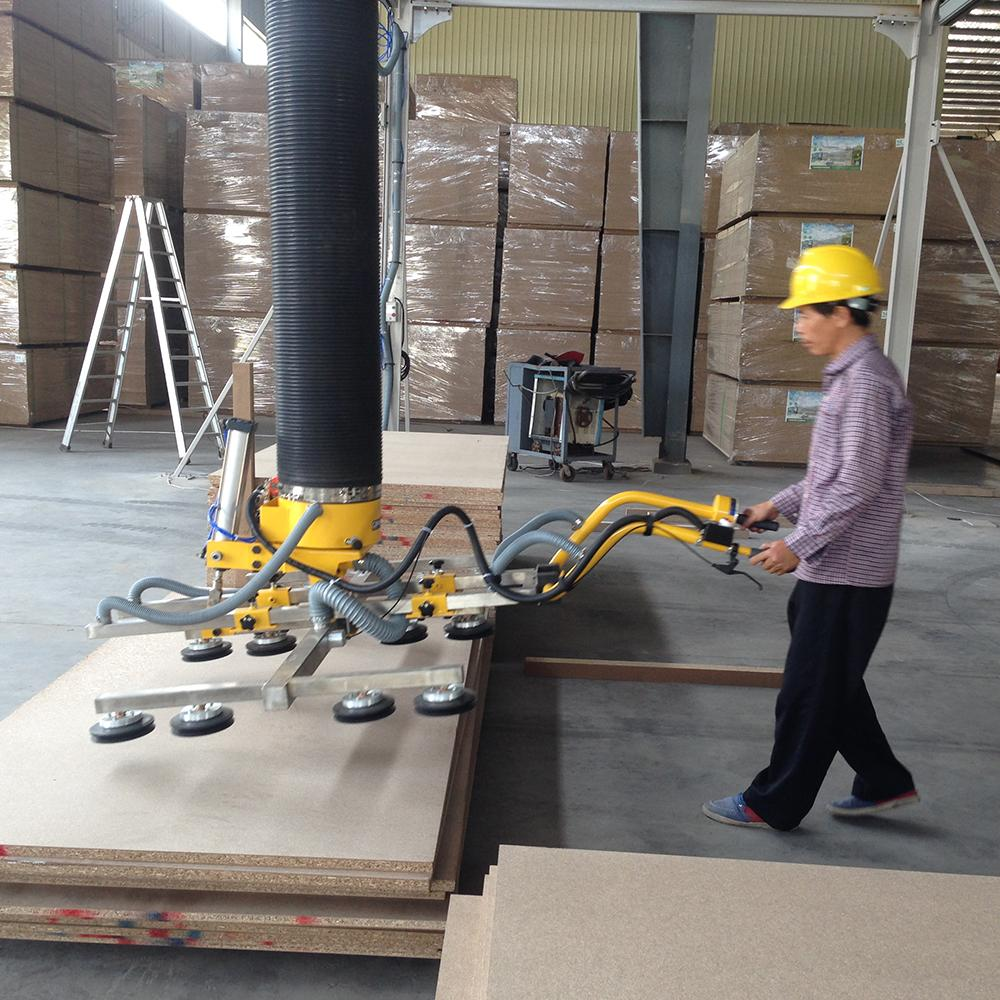
The vacuum lifting system shown in the application is designed for industrial material handling environments where operators need to move large wood boards, plywood, MDF, particle boards, and other sheet materials efficiently. With multiple suction cups, a flexible lifting structure, and an ergonomic control handle, the equipment allows operators to lift, move, and position large panels with greater control.
What Is an Industrial Vacuum Lifter?
An industrial vacuum lifter is a material handling device that uses vacuum pressure to attach suction pads to a workpiece. Once the vacuum is established, the lifting mechanism can raise and move the material to another location.
Unlike conventional mechanical clamps, vacuum lifting does not require the operator to manually hold or clamp the edge of the workpiece. This makes it particularly useful for large flat panels that have suitable surfaces for vacuum suction.
Depending on the application, a vacuum lifter can be integrated with a crane, overhead lifting system, gantry structure, or articulated handling mechanism.
The system shown in the image combines a vacuum lifting unit with multiple suction cups and an operator-controlled handling arm. This configuration is suitable for repetitive panel handling operations in factories and warehouses.
How Does a Vacuum Panel Lifter Work?
The basic operating process is relatively simple.
First, the suction cups are positioned against the surface of the panel. The vacuum system then generates negative pressure inside the suction cups, creating a secure connection between the lifting device and the workpiece.
Once sufficient vacuum is established, the panel can be lifted from a stack and moved to another position. The operator uses the control handle to guide the lifting mechanism and accurately position the material.
This operating principle can significantly reduce the physical effort required when handling large panels.
For production environments, the vacuum lifter can be configured according to the size, weight, surface characteristics, and handling requirements of the material.
Key Features of an Industrial Vacuum Lifting System
Multiple Vacuum Suction Cups
The lifting head can be equipped with multiple suction cups distributed across the panel surface. This configuration helps spread the lifting force over a larger area.
Different suction cup arrangements can be considered depending on the dimensions and shape of the workpiece.
Ergonomic Operator Control
An ergonomic control handle allows the operator to control the lifting and positioning movement directly.
This is particularly useful in applications where panels need to be transferred repeatedly from stacks to production equipment, worktables, or other processing areas.
Large Panel Handling
Large boards can be difficult for one operator to handle manually because of their dimensions rather than their weight alone.
A vacuum panel lifter provides a mechanical handling solution for oversized materials while allowing the operator to guide the movement.
Flexible Configuration
Vacuum lifting equipment can be customized for different workpieces.
Possible configuration factors include:
- Lifting capacity
- Suction cup quantity
- Suction cup diameter
- Panel dimensions
- Vacuum supply
- Lifting height
- Horizontal reach
- Control method
- Working environment
This flexibility makes vacuum lifting technology suitable for different manufacturing and material handling applications.
Applications of Vacuum Panel Lifters
An industrial vacuum lifter can be used in a variety of industries where large flat materials need to be moved frequently.
Woodworking and Furniture Manufacturing
Woodworking factories often handle plywood, MDF, particle board, laminated panels, and furniture boards.
A vacuum panel lifter can help transfer boards from storage stacks to processing equipment, cutting tables, assembly stations, or other production areas.
Panel Processing
During cutting, drilling, laminating, and CNC processing operations, large panels may need to be loaded and unloaded repeatedly.
Vacuum lifting equipment can help streamline these material transfer processes.
Construction Material Handling
Large boards and sheet materials can also be handled in building material production and distribution facilities.
The lifting system can be configured for specific material sizes and handling requirements.
Metal Sheet Handling
With an appropriate vacuum configuration, vacuum lifting technology can also be used for certain metal sheet handling applications.
The surface condition, material characteristics, weight, and vacuum compatibility should be evaluated before selecting the appropriate suction system.
Benefits of Using an Industrial Vacuum Lifter
The main benefit of vacuum lifting is the combination of mechanical lifting assistance and operator control.
Reduced Manual Handling
Large panels can be difficult to lift and move manually. A vacuum lifting system takes over much of the physical lifting work, reducing the need for manual handling.
Improved Handling Efficiency
For repetitive material transfer operations, faster lifting and positioning can help improve workflow efficiency.
Better Control During Positioning
The operator can guide the panel using the control handle, making it easier to position materials accurately.
Suitable for Repetitive Operations
When the same type of panels must be moved repeatedly throughout the working day, a vacuum lifter can provide a consistent handling method.
Adaptable to Different Production Layouts
The lifting equipment can be designed according to the available workspace, material flow, lifting height, and production process.
How to Choose the Right Vacuum Lifter?
Choosing an appropriate vacuum panel lifter requires more than simply checking the maximum lifting capacity.
The first consideration should be the workpiece weight. The vacuum lifting system must have sufficient capacity for the heaviest material being handled.
The second factor is the workpiece dimensions. Large panels may require multiple suction points to achieve stable lifting.
The surface condition is also important. Smooth, clean, non-porous surfaces are generally easier to handle using conventional vacuum suction technology. Porous materials may require a specially designed vacuum system and suitable suction cups.
Other important considerations include lifting height, operating frequency, available air supply, working environment, and the required movement range.
For customized applications, manufacturers can evaluate the material characteristics and production process before determining the appropriate vacuum lifting configuration.
A Practical Solution for Modern Material Handling
As manufacturers look for ways to improve material handling efficiency and reduce repetitive manual operations, vacuum lifting technology is becoming an increasingly useful solution for large-panel handling.
An industrial vacuum lifter combines vacuum suction, mechanical lifting, and ergonomic operator control into one material handling system. For woodworking, furniture manufacturing, panel processing, and other industrial applications, it can provide a flexible way to move large and heavy sheet materials.
The right configuration depends on the workpiece and production requirements. By selecting the appropriate suction cups, lifting capacity, vacuum system, and control mechanism, manufacturers can develop a handling solution suited to their specific workflow.
Post time: Sep-28-2026