

A lift assist manipulator (often called an industrial manipulator) works by counterbalancing the weight of a heavy or awkward payload, allowing an operator to lift, move, and rotate objects with minimal physical effort. It essentially acts as a mechanical extension of the operator’s own arms, providing strength and precision while absorbing the strain.
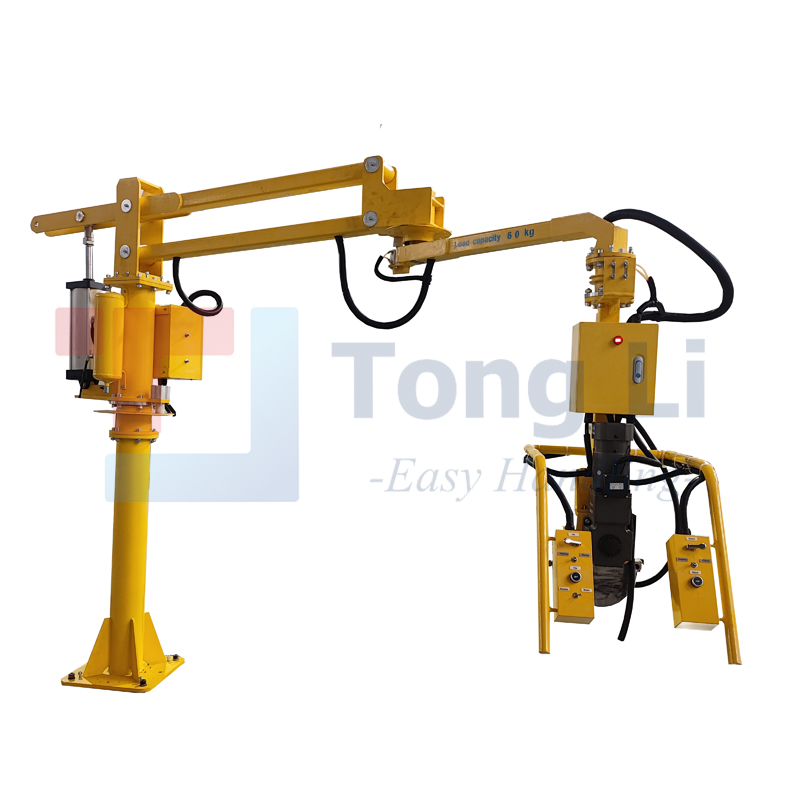
Here is a step-by-step breakdown of how the entire system functions, from the core physics to the operator’s control.
1. The Core Principle: Mass Counterbalancing
The fundamental magic of a manipulator is making a 200 kg (440 lbs) object feel weightless. This is achieved using one of two primary balancing systems:
-
Pneumatic Balancing (Most Common): The system uses a precision air cylinder regulated by special balancing valves. When a load is picked up, the air pressure inside the cylinder is adjusted to exactly match the downward gravitational force of that load.
-
Electronic/Servo Balancing: High-speed electric servo drives and load cells continuously measure the weight. A motor then provides an equal and opposite lifting force.
The “Float” State: Once balanced, the system enters a “zero-gravity” or float state. The operator can literally push the heavy payload up or down using just a few finger widths of force.
2. Structural Articulation (The Skeleton)
To move the load seamlessly through a 3D workspace, manipulators rely on specialized mechanical structures:
-
Articulated Arms: These mimic a human arm with a shoulder, elbow, and wrist joint. They provide excellent flexibility and allow the operator to reach around obstacles or into tight spaces (like reaching inside a car chassis to install a seat).
-
Rigid/Cantilever Jibs: For applications requiring high precision or where eccentric (off-center) loads might cause a standard cable crane to swing dangerously, rigid steel arms prevent any swaying.
-
Rotational Joints: Bearings at each joint allow for 360-degree continuous rotation, ensuring smooth horizontal movement across the factory floor.
3. The End Effector (The Gripper)
The manipulator must securely hold the workpiece. Because industrial parts vary wildly, the “hand” or end effector is almost always custom-engineered for the specific application:
-
Vacuum Suction: Uses vacuum pads to lift flat, non-porous items like glass panes, sheet metal, or cardboard boxes.
-
Mechanical Grippers: Custom jaws, clamps, or expanding mandrels that mechanically lock onto a part (e.g., gripping the inner diameter of a heavy roll of film or the outer rim of a car tire).
-
Magnetic Lifters: Permanent or electro-magnets used for heavy ferrous metal parts like engine blocks.
4. The Control System & Human Interface
How does the manipulator know when to lift and when to let go? It relies on intuitive control logic:
Dual-Circuit Balancing
Most traditional systems use a two-button or automatic switching circuit:
- 1
No-Load Balance: When the gripper is empty, the system regulates pressure so the gripper itself floats effortlessly.
- 2
Load Balance: Once the operator activates the gripper on a part, the system detects the pressure change (or the operator flips a switch) and instantly ramps up the air pressure to balance the combined weight of the gripper and the part.
Force-Sensing / Intuitive Controls
Modern electronic manipulators use force-sensing handles. When the operator pushes the handle down, the system detects the downward human force and actively drives the motor downward. If the operator lifts up, the system assists upward. The machine amplifies the user’s intent in real-time.
5. Built-in Safety Mechanisms
Because these machines handle massive weights near human operators, they incorporate critical safety features:
-
Anti-Drop Protection: If the factory suddenly loses pneumatic air pressure or electrical power, check valves lock the air inside the cylinder, preventing the load from dropping unexpectedly.
-
Brake Systems: Pneumatic or mechanical brakes lock the joints in place when the machine is idle or if an emergency stop is pressed.
-
Interlocks: The system will not allow the gripper to open and release the payload unless the weight sensor detects that the load is securely resting on a solid surface (preventing accidental mid-air drops).
Post time: Jul-02-2026