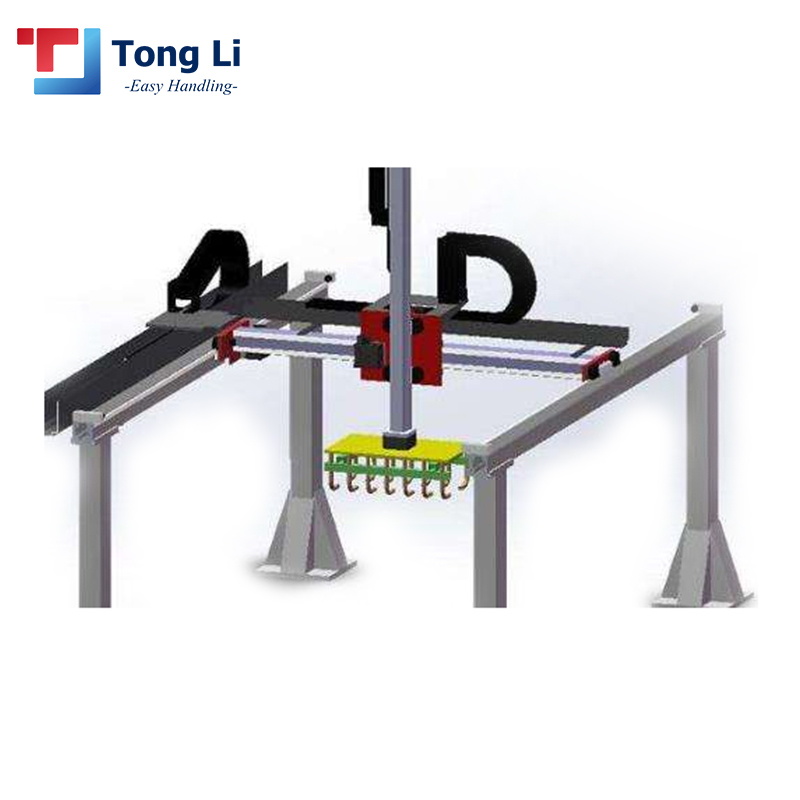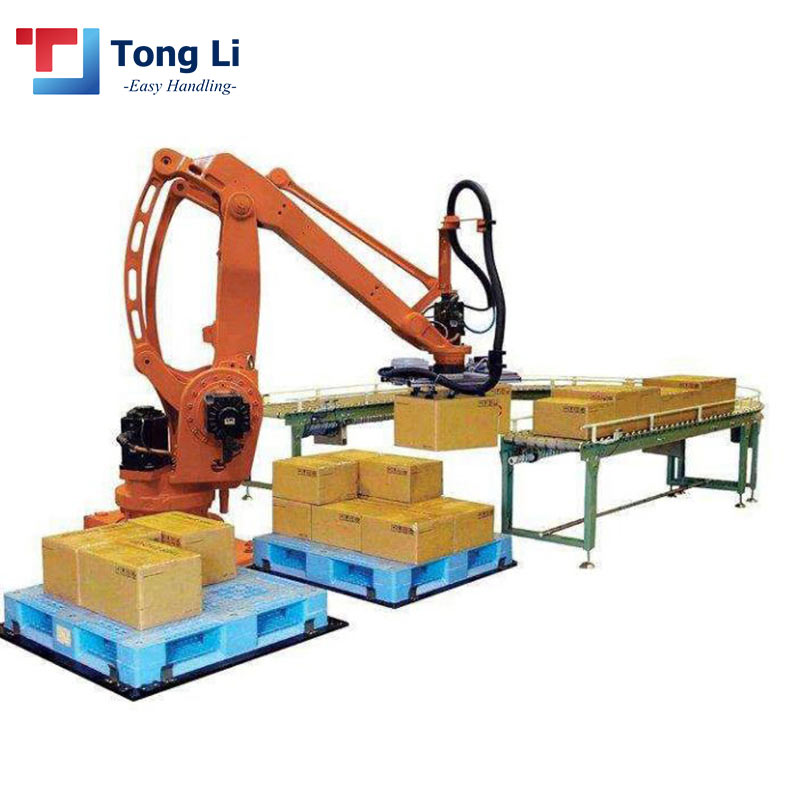


Carton palletizing robot
How It Works: The Workflow
The process typically follows a four-step cycle:
-
Infeed: Cartons arrive via a conveyor. Sensors or vision systems detect the box’s position and orientation.
-
Pick: The robot arm moves its End-of-Arm Tooling (EOAT) to the box. Depending on the design, it may pick one box at a time or a whole row/layer.
-
Place: The robot rotates and positions the box onto the pallet according to a “recipe” (a software pattern designed for stability).
-
Pallet Management: Once a pallet is full, it is moved (manually or via conveyor) to a stretch wrapper, and a new empty pallet is placed in the cell.
Key Component: End-of-Arm Tooling (EOAT)
The “hand” of the robot is the most critical part of a carton system. Common types include:
-
Vacuum Grippers: Use suction to lift boxes from the top. Ideal for sealed cartons and different sizes.
-
Clamp Grippers: Squeeze the sides of the box. Best for heavy or open-top trays where suction might fail.
-
Fork/Under-Slung Grippers: Slide tines under the box. Used for very heavy loads or unstable packaging.
Why Automate? (Top Benefits)
-
Reduced Injury Risk: Eliminates Musculoskeletal Disorders (MSDs) caused by repetitive lifting and twisting.
-
Higher Density Stacks: Robots place boxes with millimeter precision, creating more stable pallets that are less likely to tip during shipping.
-
24/7 Consistency: Unlike human operators, robots maintain the same cycle time at 3:00 AM as they do at 10:00 AM.
-
Scalability: Modern “no-code” software allows floor staff to change stacking patterns in minutes without needing a robotics engineer.