

A pneumatic manipulator—also called a pneumatic balancer or articulated arm manipulator—is an industrial lift‑assist device that uses compressed air to counterbalance a load so an operator can lift, move, tilt, and rotate heavy or awkward items with minimal effort and high control.
If you’re searching for what a pneumatic manipulator is, you likely want to know when it’s the right tool versus electric manipulators or vacuum lifters. Here’s the deal: its standout advantage is operator ergonomics and safety—float (near zero‑gravity) handling, anti‑drop measures, and intuitive controls that keep training simple.
What is a pneumatic manipulator and how it works
Think of the balancer like a finely tuned counterweight that’s powered by air. Compressed air pressurizes a cylinder inside the arm to generate an upward force. When set correctly, the system balances the load so it “floats.” The operator guides placement with a handle or directly on the part in float mode.
- Core components you’ll see in most designs: a floor column or overhead trolley, articulated arms with joints, a pneumatic balancer/air cylinder module, control valves and an air prep unit (filter/regulator), an operator handle with enable/E‑stop, and a task‑specific end‑effector such as a clamp, mandrel, hook, magnet, or—when suitable—vacuum tooling.
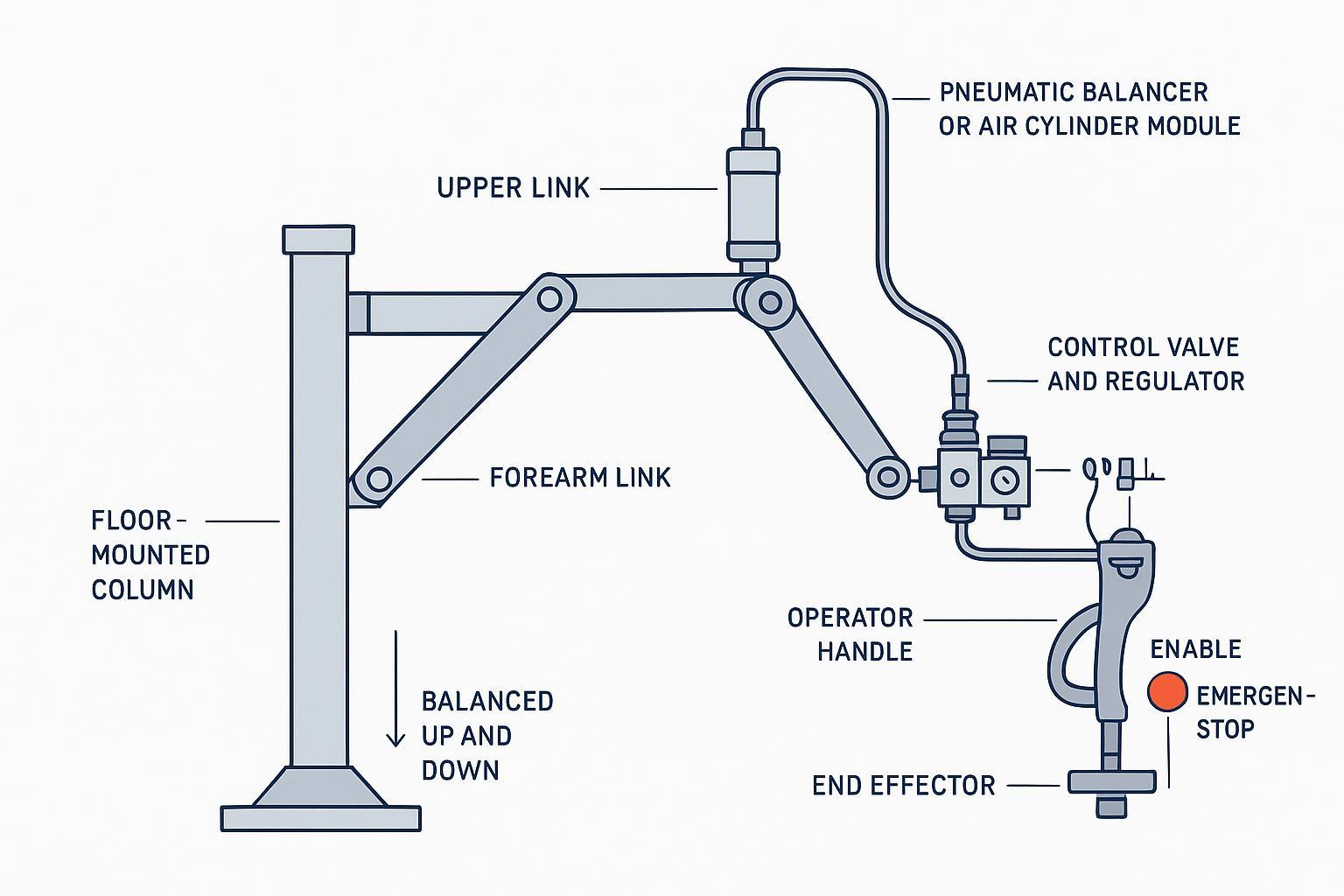
What “float” actually means
- In float (auto‑balance) mode, the arm maintains near‑neutral buoyancy so a gentle push up or down moves the load proportionally, then it holds position. This feel is well documented in industrial assist devices and manipulators that offer float/zero‑gravity behavior for precise, low‑effort placement, as described in manufacturer explainers such as the overview of pneumatic manipulators and auto‑balancing from INDEVA and in handling product manuals that detail float mode and limits in practice.
Air matters
- Responsiveness and safety depend on clean, dry air at the right pressure/flow with proper hose sizing. As an example, Endo Kogyo’s air balancer instructions advise regulated supply (not exceeding about 0.7 MPa), filtration, and adequate hose diameter (often ≥3/8 in ID) to minimize pressure drop—practical guidance that applies across brands.
- Responsiveness and safety depend on clean, dry air at the right pressure/flow with proper hose sizing. As an example, Endo Kogyo’s air balancer instructions advise regulated supply (not exceeding about 0.7 MPa), filtration, and adequate hose diameter (often ≥3/8 in ID) to minimize pressure drop—practical guidance that applies across brands.
Pneumatic vs electric vs vacuum — quick comparison
| Solution | Where it excels | Considerations |
|---|---|---|
| Pneumatic manipulator | Fast, intuitive float handling; rugged; compatible with ATEX‑rated components when required; good for heavy/awkward loads | Needs quality compressed air; validate anti‑drop and interlocks; plan column/overhead structure |
| Electric manipulator | Programmable motion, precision placement, data/diagnostics | Requires power cabling and controls integration; may be preferred for complex paths and high repeatability |
| Vacuum lifter | Flat, clean, non‑porous panels (sheet metal, glass, plastics); wide pad arrays | Seal quality is critical; porous/oily/curved surfaces can leak—mitigations exist but must be engineered (see suction‑cup design guidance from Schmalz’s knowledge page on suction cup shapes and applications) |
Post time: Mar-02-2026