

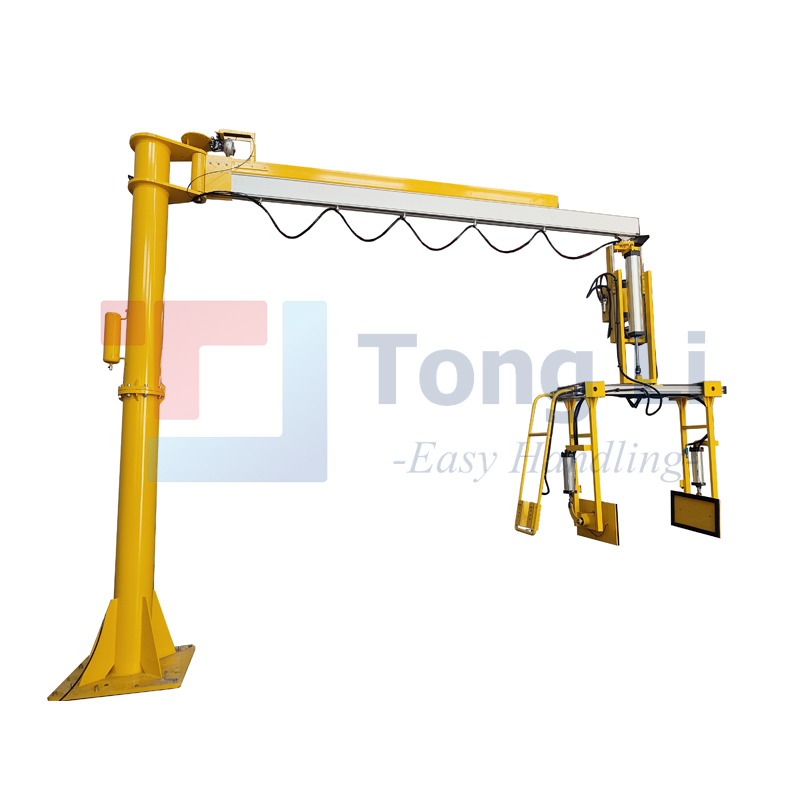
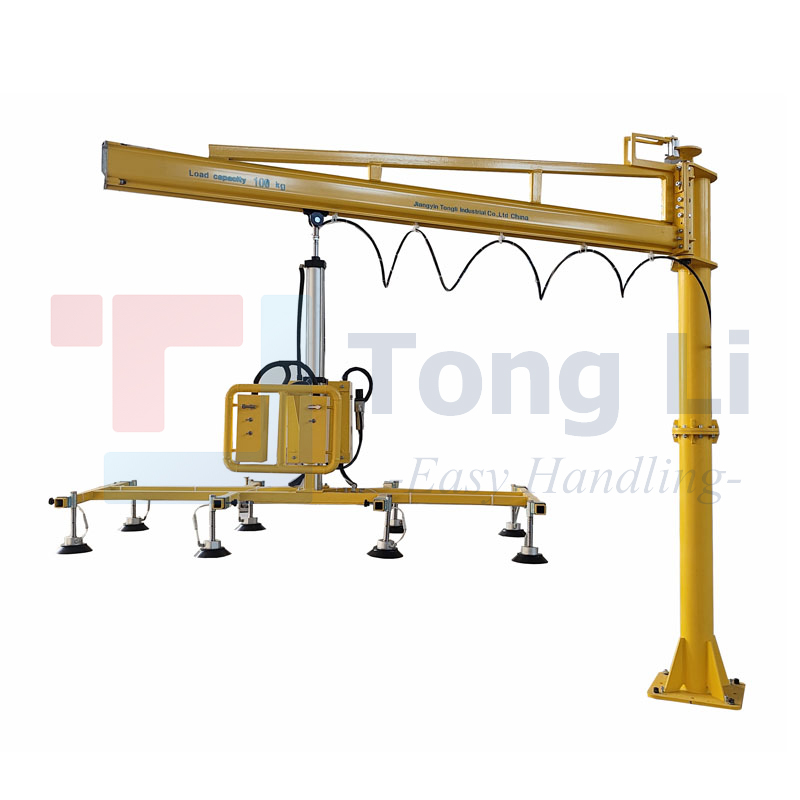
Cantilever pneumatic manipulators are industrial lifting devices that use a rigid, single-sided support arm (the cantilever) and compressed air to neutralize the weight of a load. By creating a “zero-gravity” state, they allow operators to move heavy or awkward objects with fingertip control.
In modern production, they act as a bridge between manual labor and full robotics, simplifying processes where human judgment is still required but physical strength is a bottleneck.
How They Simplify Production
These manipulators streamline workflows by addressing the “physical physics” of the factory floor:
Handling Offset Loads: Unlike traditional hoists that must be directly above a load, the cantilever (rigid arm) design allows an operator to reach inside a machine, under an overhang, or into a furnace.
Zero-Gravity Precision: The pneumatic system senses the weight and provides an equal upward force. This allows a 100kg car door to “float,” so the operator can focus entirely on alignment rather than the struggle of holding the weight.
Eliminating Secondary Support: Tasks that previously required two or three workers to stabilize a part can now be performed by a single operator, effectively doubling or tripling labor efficiency.
Integration with Industry 4.0
Modern cantilever systems are no longer “dumb” mechanical arms. They are increasingly integrated into smart factory ecosystems:
- PLC Interfacing: The manipulator can communicate with the production line’s main controller (PLC) to ensure it only releases a part when it is correctly seated in a jig.
- Auto-Weight Sensing: Advanced sensors automatically adjust the air pressure when the operator picks up a new object, meaning they don’t have to manually “set” the weight for different parts on a mixed-model line.
- Data Logging: Some systems track the number of cycles and “near-miss” safety events, providing data for predictive maintenance and lean process optimization
Post time: Jan-19-2026