

In modern manufacturing, assembly, and logistics, the push for throughput often collides with a critical limiting factor: human ergonomics. Heavy lifting, awkward angles, and highly repetitive pick-and-place tasks not only slow down production but also lead to expensive musculoskeletal injuries (MSDs).
While fully automated robotics are excellent for highly standardized, high-volume production lines, they lack the flexibility, quick adaptation, and real-time decision-making of a human operator.
This is where the manual load manipulator—often called an industrial manipulator, balance crane, or assist arm—comes in. By bridging the gap between human dexterity and mechanical power, these systems allow a single operator to lift, rotate, tilt, and position heavy or awkward payloads effortlessly.
If your facility is evaluating material handling upgrades, this engineering-focused guide outlines how manual load manipulators work, their primary benefits, and how to select the right system configuration. For custom material handling solutions, explore the specialized handling equipment at TLManipulator.
What is a Manual Load Manipulator?
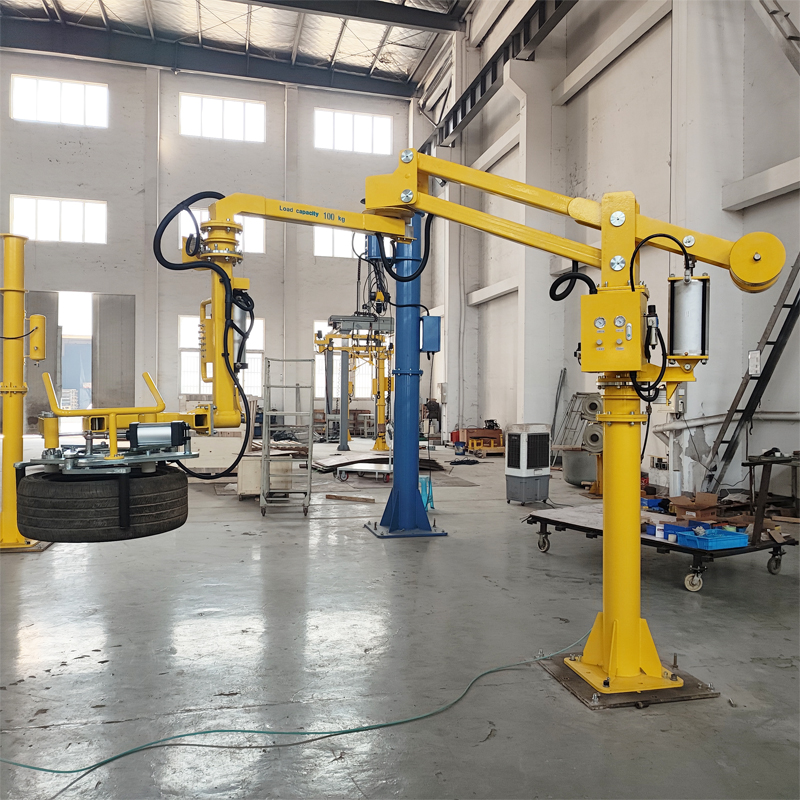
A manual load manipulator is an operator-controlled, power-assisted lifting device designed to neutralize the weight of a payload. Unlike simple hoists that only move vertically, a manipulator provides a full three-dimensional work envelope.
Using specialized pneumatic, hydraulic, or electronic balancing systems, the manipulator creates a “weightless” float state. Once the operator grips the handle, the payload behaves as if it weighs practically nothing, allowing for fluid, precise placement without physical strain.
3 Core Technologies: Rigid Arm vs. Soft Cable
The mechanical structure of a manual load manipulator determines how it handles offset loads and rotational forces. The two most common configurations are:
1. Rigid Arm (Pneumatic/Mechanical) Manipulators
These systems use a solid, articulated steel or aluminum arm. Because the arm is rigid, it can handle cantilevered (offset) loads and resist torque.
-
When to use: If you need to reach into an enclosure (like placing an engine block into a chassis), tilt or rotate a part 90 to 180 degrees, or grip a part off-center.
-
Why it matters: Standard hoists cannot handle side-loading or moment forces; a rigid manipulator handles them safely.
2. Soft Cable (Balance Crane) Manipulators
These systems use a high-strength cable or chain suspended from an overhead structure or arm.
-
When to use: Best for rapid, vertical pick-and-place cycles where the load is picked up directly from its center of gravity.
-
Why it matters: They offer exceptional speed, high vertical travel, and a lighter physical footprint, though they cannot handle severe offset loads or provide rigid rotational control.
3. Vacuum Tube Lifters
These systems combine the lifting mechanism and the gripping mechanism into one. A single vacuum tube contracts to lift the load and expands to lower it.
-
When to use: Ideal for rapid box stacking, bag lifting, and sheet metal handling.
Crucial Selection Criteria: Choosing Your Manipulator
An industrial manipulator project rarely fails because of lift capacity alone; failures usually happen when the device is mismatched with the operational environment, duty cycle, or grip requirements. When selecting a system, evaluate these four criteria:
1. Payload Characteristics & Center of Gravity
You must define the minimum, average, and maximum weight of the parts, along with their physical dimensions. Crucially, locate the payload’s center of gravity (CoG). If the CoG shifts during rotation (for example, tilting a hollow container), the manipulator’s tooling must be engineered to rotate along that changing axis to prevent sudden slips or jerks.
2. End-of-Arm Tooling (The Gripper)
The manipulator is only as good as the interface between the machine and the part. Gripper types include:
-
Pneumatic Clamps: Mechanical jaws that pinch or hold a part.
-
Vacuum Suction Pads: Best for flat, non-porous surfaces like glass, sheet metal, or cardboard cartons.
-
Expandable Mandrels: Grippers that insert into a core or ID (inner diameter) and expand outward to lift rolls, coils, or pipes.
3. Mounting Options and Work Envelope
Your floor plan and structural columns dictate how the manipulator should be mounted:
-
Column/Floor-Mounted Jib: A self-supporting pillar bolted to the floor, providing a 360-degree working radius within a fixed cell.
-
Overhead Rail/Bridge Suspension: Suspended from overhead steel tracks, allowing the operator to cover a massive, rectangular work area across multiple assembly stations.
-
Mobile/Portable Bases: Mounted on a heavy counterweighted steel base plate that can be moved via forklift to different areas of the facility.
4. Air and Power Supply Requirements
Most high-reliability manual manipulators run on compressed air (pneumatics). Pneumatic systems are preferred in manufacturing because they are highly reliable, explosion-proof, and can hold a load in a suspended float state indefinitely without overheating. You must ensure your facility has clean, dry, regulated air (typically 6–7 bar) at the installation site.
Real-World Applications
Manual load manipulators are critical assets across a variety of industrial sectors:
| Industry | Typical Application | Key Benefit |
| Automotive | Installing heavy seats, dashboards, engines, and batteries into vehicles. | Precision alignment without scratching paint or damaging delicate components. |
| Packaging & Warehousing | Palletizing and depalletizing heavy bags, boxes, and drums. | Eliminates lower-back injuries while maintaining high cycle speeds. |
| Metalworking & Foundry | Feeding heavy metal plates into CNC machines or lifting hot castings. | Keeps operators at a safe distance from heat, sharp edges, and pinch points. |
| Paper, Film & Foil | Lifting, rotating, and loading heavy rolls of material onto unwind shafts. | Rotates rolls from horizontal to vertical orientation seamlessly. |
Safe Operation and the Ergonomic Payback
Investing in a manual load manipulator is one of the fastest ways to improve plant safety metrics. By removing the physical stress of lifting, operations managers see immediate returns:
-
Reduced Absenteeism & Workers’ Comp: Lowering the risk of repetitive strain injuries and acute back strains.
-
Consistent Production Pace: Operators do not tire out toward the end of an 8-hour shift, keeping cycle times stable from morning to night.
-
Workforce Inclusivity: Anyone can lift a 150 kg payload effortlessly, widening the pool of eligible operators for heavy-assembly roles.
If you are looking to optimize your assembly lines, reduce operator strain, and select a system custom-built for your specific payloads, consult the engineering team at TLManipulator to find the ideal manual load manipulator for your workflow.
Post time: Jul-15-2026