

Paper, film, textile, flexible packaging and battery separator production lines face long-standing pain points when transporting cylindrical roll materials: heavy manual lifting causes frequent occupational injuries, external clamping easily scratches valuable roll surfaces, and inaccurate centering leads to winding defects and massive material waste.
The roll core gripping manipulator, an internal expansion mandrel handling robot, has become a mainstream automation upgrade choice for roll processing factories worldwide. It inserts an expanding shaft into the paper/plastic core tube and grips from inside the roll, eliminating external extrusion damage while realizing automatic loading, unloading, rotating and palletizing of all types of rolls. Industry data shows the global demand for core gripping roll manipulators grows 9.2% annually, driven by the booming flexible materials manufacturing sector.
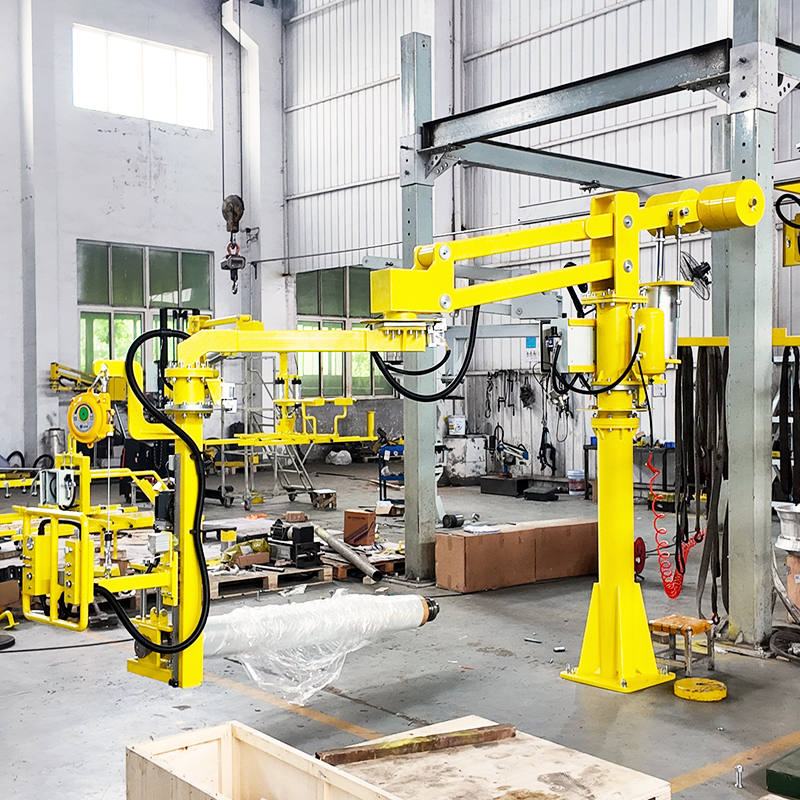
1. Working Principle & Core Structural Design of Roll Core Gripping Manipulators
Different from external jaw grippers that clamp roll outer surfaces, roll core gripping manipulators adopt an internal expansion mandrel end effector as the core gripping unit.
- Pneumatic/electric expansion shaft: The mandrel stretches three sets of serrated friction blocks outward after inserting into the roll core, forming uniform inner-wall holding force with a safety factor above 2:1 to prevent accidental falling during high-speed transfer.
- Replaceable core adapters: Quick-change tooth sleeves support common core sizes including 3-inch, 6-inch and 12-inch, compatible with paper, plastic and metal core tubes without tool replacement.
- Multi-axis rotating mechanism: Integrates 360° horizontal rotation and 90° vertical tilting, switching rolls between vertical stacking and horizontal machine feeding freely.
- Safety protection modules: Overload anti-crush sensor and load-locked release valve avoid roll damage and sudden drop accidents, fully complying with OSHA industrial safety standards.
The whole manipulator can be matched with overhead truss robots, gantry systems, column-assisted manipulators and AGV mobile racks to realize full-line unmanned roll handling.
2. Unique Advantages Over Traditional External Clamping Equipment
-
●Zero surface damage to sensitive rolls
All clamping force acts on the inner core tube, with no contact with film, paper or textile outer layers. This solves the long-term problem of indentation, scratch and edge deformation of high-value optical film, lithium battery separator and medical packaging rolls.
-
●Strong universal adaptability
Works for ultra-light 5kg yarn rolls and heavy-duty 1-ton industrial paper rolls; fits narrow slitting workshop space and high-rise automatic warehouse stacking scenes.
-
●Higher positioning precision
Inner mandrel centering ensures coaxial accuracy within ±0.1mm, perfectly matching winding machines, coating lines and slitting equipment to reduce winding deviation waste.
-
●Greatly improved workshop space utilization
No extra reserved space for external clamping jaws; overhead truss-mounted core gripping manipulators save over 35% ground area compared with forklift roll handlers.
-
●Lower long-term operation cost
Wear-resistant alloy expansion blocks extend service life; integrated automatic control reduces manual intervention by 70% for continuous production lines.
3. Main Industrial Application Scenarios & Factory Cases
3.1 Flexible Packaging & Printing Industry
Label film, plastic film and printing paper rolls are the largest application market. A Southeast Asian packaging printing plant previously relied on two workers to carry 200kg master rolls manually, with 12–15 scratch waste rolls generated every day. After deploying automatic truss-mounted roll core gripping manipulators, daily waste loss dropped by 92%, and one production line saved 3 labor positions.
3.2 Lithium Battery Separator & New Energy Film Manufacturing
Battery separators are ultra-thin and easily damaged, requiring strict internal core gripping without external pressure. Heavy-duty core gripping manipulators realize automatic transfer from calender to winding machine, with stable 24-hour unmanned operation and zero defective products caused by handling.
3.3 Textile & Non-woven Fabric Production
Spunlace non-woven, textile yarn cones and carpet rolls widely adopt vertical core gripping manipulators for palletizing and warehouse storage. The tilting function easily turns vertical fabric rolls horizontal for loom feeding, greatly reducing worker waist strain injuries.
3.4 Paper & Paperboard Processing
Newspaper base paper, kraft paper and tissue paper large rolls rely on heavy-load core gripping manipulators for workshop transfer. The anti-slip serrated mandrel avoids core tube slipping under high humidity factory environments.
3.5 Medical & Food Flexible Film Cleanroom Lines
Stainless steel hygienic-style roll core gripping manipulators are customized for clean workshops, with sealed pneumatic components and dust-free expansion blocks, meeting food packaging and medical film production sanitation standards.
For customized roll core gripping manipulators and integrated truss automatic roll handling production lines adapted to film, paper and textile workshops, manufacturers can view complete technical parameters, on-site project videos and industry case studies via [Your Official Website URL]. The provider offers one-stop services including scheme design, mechanical production, PLC control programming and global after-sales installation.
4. Intelligent Upgrade Trend of Core Gripping Manipulators
Modern roll core gripping manipulators are no longer independent handling equipment, but connected nodes of smart factory digital systems:
- Vision-assisted automatic core alignment: Cameras identify offset roll cores and adjust mandrel insertion position automatically, no manual fine-tuning needed.
- MES data interconnection: Upload roll weight, transfer beat and equipment fault data to factory management systems for production efficiency analysis.
- Collaborative human-machine mode: Safety laser sensors enable co-working between operators and manipulators without full safety fences, suitable for small-batch flexible production.
- Modular lightweight design: Standardized expansion mandrel modules shorten delivery cycles by 40% for medium and small factories.
5. Market Outlook
Global web material manufacturers are accelerating automation transformation to cope with labor shortages and stricter product quality standards. Roll core gripping manipulators, with irreplaceable advantages in protecting roll surfaces and high-precision feeding, will maintain stable market expansion.
For small and medium-sized factories with limited budgets, matching core gripping end effectors with existing truss manipulators is a low-cost automation upgrade solution, avoiding full production line reconstruction investment.
Conclusion
Roll core gripping manipulators have solved the core pain point of damage-prone roll material transportation for decades. Combined with truss robots, gantry systems and intelligent warehouse equipment, they build closed-loop unmanned production lines from raw roll feeding to finished product palletizing. As flexible material industry upgrading speeds up, internal core gripping handling technology will continuously expand its application scope across printing, new energy, textile and medical manufacturing sectors.
Post time: Jun-17-2026