

What Is a Pneumatic Manipulator?
A pneumatic manipulator is an industrial material handling device powered primarily by compressed air. It is designed to help operators lift, move, rotate, tilt, and position heavy, bulky, or awkward workpieces with significantly less physical effort.
Unlike conventional lifting equipment such as cranes or hoists, a pneumatic manipulator can provide highly responsive, operator-controlled movement. Pneumatic balancing technology can counteract the weight of the workpiece, creating a near “zero-gravity” handling experience in suitable applications.
For manufacturers, this makes pneumatic manipulators particularly valuable in repetitive handling, machine loading and unloading, assembly, packaging, and palletizing operations.
If you are looking for a complete industrial material handling solution, explore our industrial manipulator solutions.
How Does a Pneumatic Manipulator Work?
The operating principle of a pneumatic manipulator is based on controlled compressed-air power.
A typical system includes a pneumatic cylinder, articulated or rigid arm, control mechanism, mounting structure, and customized end effector.
The basic operating process includes:
- Compressed air supply
Factory compressed air enters the pneumatic control system. - Pneumatic actuation
Air pressure drives the cylinder or balancing mechanism to generate lifting force. - Load balancing
The pneumatic system compensates for the weight of the workpiece and handling tool. - Operator-controlled movement
The operator guides the arm to lift, lower, move, rotate, or position the workpiece. - Load release
Once the workpiece reaches the required position, the gripper or tooling releases it safely.
The result is a smooth and controllable material handling process. Proper air quality, pressure regulation, and system configuration are important for stable performance.
Key Benefits of Pneumatic Manipulators
1. Reduced Operator Physical Effort
Heavy and repetitive manual lifting can create fatigue and ergonomic challenges. A pneumatic manipulator transfers much of the load-bearing work from the operator to the pneumatic system.
This allows workers to concentrate on positioning and process control instead of physically lifting the entire workpiece.
2. Smooth and Precise Handling
Pneumatic manipulators can provide controlled movement for lifting and positioning operations. Compared with suspended loads that may swing, rigid-arm configurations can provide better stability during positioning.
This is especially useful when components must be aligned accurately with machines, fixtures, assembly stations, or pallets.
3. Improved Workplace Ergonomics
Ergonomics is an important consideration for manufacturers handling heavy or awkward products repeatedly.
A pneumatic manipulator can reduce repetitive lifting, bending, stretching, and manual carrying. This can help create a more operator-friendly workstation while maintaining production efficiency.
4. Flexible End-of-Arm Tooling
One of the most important advantages of an industrial manipulator is the ability to customize its end effector.
Depending on the workpiece, a pneumatic manipulator can be equipped with:
- Mechanical clamps
- Vacuum suction tools
- Hooks
- Grippers
- Magnetic lifting tools
- Custom fixtures
- Specialized handling devices
The correct tooling depends on the product’s weight, dimensions, surface characteristics, shape, and required movement.
5. Suitable for Repetitive Material Handling
Manufacturing operations often involve repeated lifting and positioning of the same or similar products. A pneumatic manipulator can provide consistent assistance throughout the production cycle.
Common applications include loading and unloading, assembly, packaging, palletizing, and machine tending.
Common Applications of Pneumatic Manipulators
Machine Loading and Unloading
Pneumatic manipulators can assist operators in loading and unloading workpieces from CNC machines, presses, production equipment, and processing stations.
For heavy metal components or irregularly shaped parts, the manipulator can reduce manual handling requirements while improving positioning consistency.
Assembly Operations
During assembly, workers may need to hold and position large or heavy components precisely.
A pneumatic manipulator can support the component while the operator performs fastening, alignment, inspection, or installation tasks.
Packaging and Palletizing
Boxes, bags, drums, containers, and other packaged products can be difficult to handle repeatedly.
Pneumatic manipulators can help operators pick up products and transfer them to pallets, conveyors, packaging machines, or other production areas.
Metal and Automotive Manufacturing
Automotive and metalworking facilities frequently handle components that are too heavy or awkward for comfortable manual lifting.
Typical workpieces include:
- Metal sheets
- Automotive components
- Engine parts
- Tires
- Panels
- Molds
- Castings
- Machine components
Pneumatic handling equipment can improve ergonomics while maintaining the flexibility required for different production tasks.
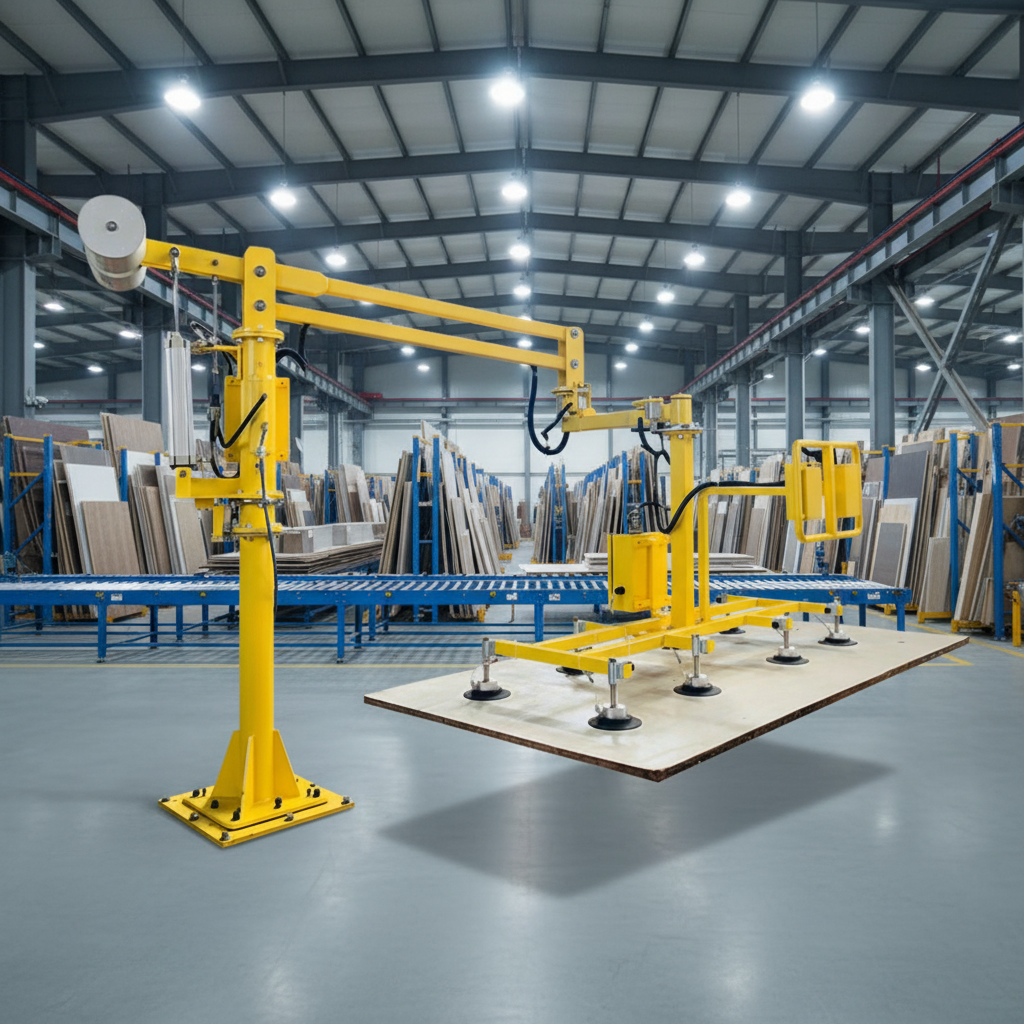
Roll Handling
Large film, paper, foil, textile, and other industrial rolls can be difficult to lift, rotate, and position manually.
A pneumatic manipulator equipped with suitable gripping or clamping tooling can provide controlled roll handling throughout production and packaging processes.
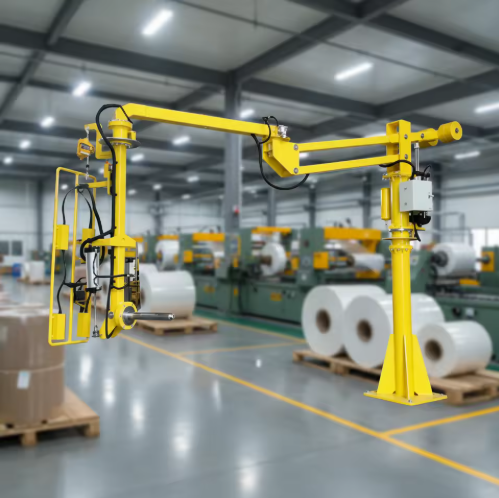
Pneumatic Manipulator vs. Traditional Lifting Equipment
Choosing the right material handling technology depends on the application.
| Equipment | Main Strength | Typical Application |
| Pneumatic Manipulator | Flexible, ergonomic, precise handling | Assembly, machine tending, material handling |
| Overhead Crane | Heavy-duty lifting over large areas | Large and extremely heavy loads |
| Electric Hoist | Vertical lifting and transfer | General lifting operations |
| Vacuum Lifter | Surface-based lifting | Panels, glass, sheets, cartons |
| Industrial Robot | High automation and repeatability | Fully automated production lines |
A pneumatic manipulator is particularly attractive when manufacturers want to combine human flexibility with mechanical lifting assistance rather than completely remove the operator from the process.
How to Choose the Right Pneumatic Manipulator
Selecting a pneumatic manipulator should start with the actual handling requirements rather than simply choosing a standard model.
Payload Capacity
Determine the maximum weight of the workpiece, including the end effector and any additional tooling.
Working Radius
The arm must provide sufficient horizontal and vertical reach to cover the complete handling area.
Workpiece Characteristics
Consider:
- Weight
- Shape
- Dimensions
- Center of gravity
- Surface material
- Fragility
- Temperature
- Whether the product is porous, smooth, cylindrical, or irregular
Required Movement
Identify whether the application requires:
- Vertical lifting
- Horizontal movement
- Rotation
- Tilting
- Turning
- Flipping
- Precise positioning
End Effector
The end effector is critical to overall system performance. A properly designed gripping tool ensures that the workpiece can be securely picked up and positioned without unnecessary product damage.
Installation Method
Depending on the factory layout, the manipulator may be installed on a floor-mounted column, workstation, overhead structure, or other suitable support system.
Pneumatic Manipulators and Factory Automation
A pneumatic manipulator does not necessarily mean completely unmanned automation. In many manufacturing environments, the most practical solution is human-machine collaboration.
The operator remains responsible for decisions and positioning, while the pneumatic manipulator provides the necessary lifting force and mechanical support.
This approach is especially useful for flexible manufacturing environments where products change frequently and a fully programmed industrial robot may not be the most economical solution.
For manufacturers evaluating ergonomic lifting and customized handling equipment, our pneumatic manipulator and material handling solutions can be configured around specific production requirements.
Safety Considerations
Safety should always be considered when integrating pneumatic handling equipment into a production line.
Important factors include:
- Correct payload selection
- Properly designed gripping tools
- Secure mounting structures
- Appropriate pneumatic control
- Load retention and anti-drop protection
- Operator training
- Regular inspection and maintenance
- Compliance with applicable machinery and workplace safety requirements
Pneumatic systems can also incorporate safety mechanisms designed to prevent uncontrolled load movement in the event of an air supply interruption, depending on the equipment configuration.
Why Choose a Pneumatic Manipulator?
For manufacturers dealing with repetitive lifting and positioning tasks, a pneumatic manipulator can provide a practical balance between automation, flexibility, and operator involvement.
The main advantages include:
- Reduced manual lifting effort
- Improved operator ergonomics
- Smooth load movement
- Better positioning control
- Flexible tooling options
- Increased handling efficiency
- Adaptability to different workpieces
- Integration with existing production processes
Rather than replacing the operator, the system acts as a mechanical extension of the operator’s capabilities.
Conclusion
A pneumatic manipulator is an effective solution for industrial material handling applications where heavy or awkward loads must be lifted, moved, rotated, and positioned safely and efficiently.
With compressed-air balancing, flexible arm movement, and application-specific end effectors, pneumatic manipulators can support machine tending, assembly, packaging, palletizing, roll handling, and many other manufacturing operations.
For companies seeking to improve workplace ergonomics while increasing handling efficiency, choosing the right pneumatic manipulator should be based on payload, reach, workpiece characteristics, movement requirements, tooling, and production environment.
For more information about industrial manipulators and customized material handling solutions, visit our Pneumatic Manipulator solutions.
Post time: Aug-24-2026