

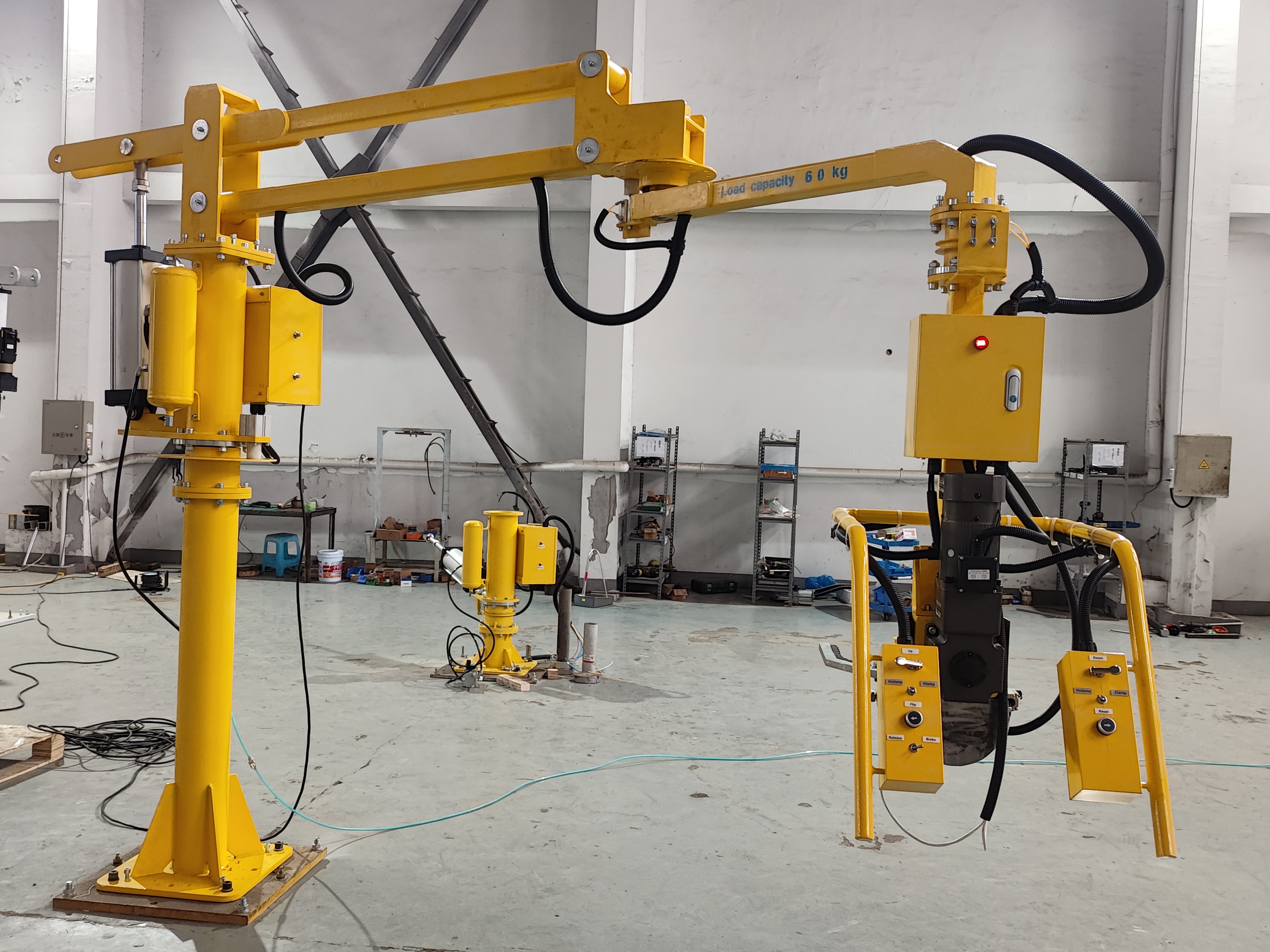
If you’re specifying lift‑assist equipment for castings and machined parts on fast, mixed‑model lines, you don’t need fluff—you need a clear path from problem to specification to purchase. This guide explains how to choose a pneumatic lifting device for automotive and machinery assembly, with a focus on variable load families, off‑center centers of gravity, and precise placement into fixtures.
What a pneumatic lifting device is—and how it differs from balancers and rigid‑arm manipulators
A pneumatic lifting device uses compressed air to help operators lift, move, and precisely position loads with far less effort. Within this family you’ll commonly encounter:
- Pneumatic balancer (also called an air balancer or zero‑gravity balancer): Optimized for smooth vertical lifting with “float” handling that lets an operator guide a balanced load with minimal force. Great for repetitive up/down moves where orientation control is modest.
- Rigid‑arm pneumatic manipulator: An articulated, rigid structure that resists sway and supports tilt/rotate/horizontal motions. Best when you need millimeter‑level placement, tight clearances, or when the load’s center of gravity sits off‑axis.
Both are pneumatic lifting devices; the right choice turns on precision, sway tolerance, and load variability.
Which pneumatic lifting device to choose for variable CoG and precision placement
For parts with shifting or offset centers of gravity—or when you’re loading into CNC fixtures, presses, or assembly nests—the rigid structure and anti‑sway behavior of a rigid‑arm manipulator usually provides higher placement accuracy than a rope or chain balancer. If your path is mostly vertical and open, and you value effortless float for speed and ergonomics, an air balancer is often the simpler fit.
- Explore rigid‑arm benefits for precision and anti‑sway in this overview of a rigid‑arm manipulator.
How to read the spec sheet before you request quotes
Before you compare models, define these parameters so vendors can size the device correctly:
- Load window: minimum/typical/maximum payload, including end‑effector mass and a safety margin.
- Center of gravity: offset distance, how it shifts during pick and place, and whether tilt/rotate is required.
- Precision: placement tolerance at the workstation; need for float mode or inching; approach speed control.
- Duty cycle and takt: expected cycles per hour, peak bursts, and permissible heat/air limits.
- Environment: available air pressure/flow and air quality targets; temperature, dust, moisture; hazardous area considerations.
- End‑effector: vacuum (cartons, sealed faces), magnetic (ferrous castings), or mechanical grippers (mixed geometries); quick‑change needs.
- Integration: mounting style (column, overhead rail, jib), reach and vertical stroke, PLC/I/O and interlocks, guarding and E‑stops, maintenance access.
Selection checklist for automotive and machinery assembly
Use this short checklist to pressure‑test your choice before procurement:
- Define the parts family: envelope, weight range, surface condition, lifting points, and variability across SKUs.
- Choose a control approach: handle with proportional up/down, pendant, or float; confirm operators can align parts without struggle.
- Match rigidity to precision: rigid‑arm for anti‑sway precision and tight fixtures; air balancer for ergonomic vertical moves.
- Plan for orientation: specify tilt/rotate degrees, locking or detents, and torque limits for off‑axis loads.
- Validate air supply: site pressure/flow at the drop; filtration/drying level to protect valves and cylinders.
- Confirm reach and clearance: horizontal radius, Z‑stroke, ceiling height, workstation guarding, and aisle constraints.
- Build in inspection points: daily checks, periodic proof‑tests per policy, and a spare‑parts plan for wear items.
Integration notes for production cells
Mounting and reach
- Column or floor‑mounted jibs suit dedicated cells; overhead rail expands coverage across multiple machines.
- For cartons and bags in kitting or line‑side replenishment, consider a purpose‑built vacuum solution like a vacuum tube lifter for cartons and bags to reduce operator strain on high‑frequency picks.
Air supply and controls
- Size for the installed line pressure and available flow, not the compressor nameplate. Keep air clean and dry to extend valve and cylinder life.
- Typical control modes include proportional up/down and float handling; add inching or speed limiting where alignment is tight.
Safety and guarding
- Include E‑stops, interlocks for under‑pressure/overload, and pinch‑point guarding. Treat end‑effectors as below‑the‑hook attachments with appropriate inspection and markings per your internal policy.
System‑level alternatives
- When your goal shifts from single‑point lift assist to high‑throughput palletizing or multi‑lane transfers, evaluate a cartesian solution in the gantry robot overview as a system‑level alternative.
Practical examples from automotive and machinery lines
- Casting into a CNC fixture: A rigid‑arm pneumatic manipulator with a magnetic or mechanical gripper lets an operator approach at low speed, hold steady without sway, and ease the casting into hard stops without collisions. See how a balance‑assisted arm is configured in this pneumatic lift manipulator arm product snapshot.
- Gearbox housing alignment in subassembly: With variable wall thickness and off‑center lifting points, a rigid arm with controlled tilt helps center the load and achieve mm‑level alignment at the dowel pins.
- Line‑side kit handling and depalletizing: For sealed cartons and many bagged items, vacuum tooling reduces strain and speeds up small‑part moves; switch to mechanical jaws where surfaces are irregular or porous.
In similar projects, teams have engaged manufacturers like TIANSHILI for application engineering on end‑effector selection and mounting layouts—kept strictly factual and tailored to the site’s constraints.
Maintenance and total cost of ownership considerations
- Daily function checks: verify lift/hold/float, inspect hoses and fittings, and ensure end‑effector seals or jaws are intact.
- Periodic inspections: schedule rope/chain or arm joint checks, braking and drop‑prevention tests, and verify labels/markings per site policy.
- Air system care: maintain filtration and drying to protect valves and cylinders; monitor pressure at the point of use.
- Spare strategy and training: stock common wear items (seals, cups, filters) and provide operator refreshers focused on alignment, float usage, and safe recovery procedures.
Post time: Mar-16-2026