

In modern industrial manufacturing, handling oversized, awkward, or extremely heavy workpieces poses a significant operational bottleneck. Manual lifting limits throughput and exposes workers to severe injury, while standard generic automation often lacks the precise payload capability or structural rigidity required.
This is where heavy load manipulators become a necessity. Designed to handle payloads ranging from several hundred kilograms to multiple tons, these robust industrial handling systems combine raw lifting power with highly customized end-effectors (grippers) to bridge the gap between human dexterity and mechanical force.
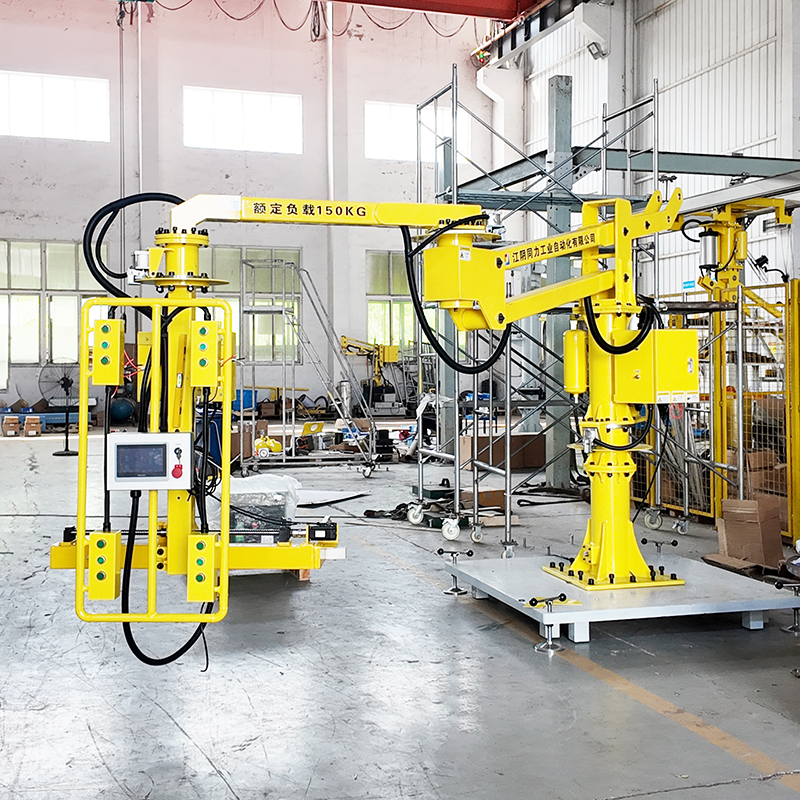
What is a Heavy Load Manipulator?
A heavy load manipulator is an engineered material handling system—pneumatic, hydraulic, or electronic—built to lift, tilt, rotate, and position high-mass objects with minimal effort from an operator or as part of a fully automated robotic line. Unlike standard light-duty vacuum lifters, heavy-duty manipulators utilize reinforced rigid arms (such as articulated or cantilever designs) to counteract the immense moments and forces generated by off-center loads.
Key Types of Industrial Manipulators
-
Pneumatic Manipulators: Ideal for weightless, fluid movement of loads up to around 500 kg, leveraging compressed air for precise positioning.
-
Hydraulic & Rigid Arm Manipulators: Used for extreme payloads (often exceeding 1,000 kg), offering massive torque and force holding capacity.
-
Articulated Gantry & Robotic Systems: Fully automated, multi-axis solutions integrated into assembly lines for high-speed, continuous heavy handling.
Primary Applications Across Key Industries
Heavy load manipulators are critical assets across sectors where large structural components must be oriented precisely for assembly, inspection, or packaging.
Automotive Manufacturing: Safely handling and positioning complete car doors, large engine blocks, windshields, heavy tire assemblies, and vehicle seats onto the chassis.
Aerospace & Defense: Moving oversized fuselage sections, wing skins, and large turbine components during tight-tolerance assembly phases.
Foundry & Heavy Machinery: Transferring raw metal castings, stamped sheet metal parts, and hot steel billets into machining centers or storage areas.
Logistics & Warehousing: High-capacity bag or box depalletizing systems handling heavy bulk raw materials.
Technical Specifications: Evaluating the Right System
When sourcing a heavy load manipulator, generic equipment rarely suffices. System integration engineers look at several distinct technical parameters to ensure structural integrity and cycle efficiency.
| Feature | Technical Requirement | Strategic Impact |
|---|---|---|
| Payload Capacity | Ranges from 200 kg to over 2,000+ kg | Dictates structural gauge, arm thickness, and drive choices. |
| Working Radius | Typically 2 to 5+ meters of horizontal reach | Defines the machine’s footprint and total factory floor coverage. |
| Degrees of Freedom | 3-axis to 6-axis articulation | Controls how complex the rotation and tilting maneuvers can be. |
| End-Effector Type | Customized mechanical clamps, magnetic grippers, or vacuum pads | Ensures secure engagement without damaging the workpiece surface. |
The Benefits of Non-Standard Customization
Because factory layouts and workpieces vary wildly, non-standard customization is the gold standard for heavy-duty material handling. Investing in an integrated, application-specific process design provides three distinct competitive advantages:
1. Optimized Floor Space and Ergonomics
Custom floor-mounted, ceiling-suspended, or overhead gantry track systems ensure the manipulator integrates cleanly into existing assembly lines without obstructing surrounding traffic.
2. Zero-Gravity Balancing
Advanced pneumatic or electronic control loops track the weight of the load dynamically. This creates a “weightless” feel for manual operators, allowing a single worker to guide a 500 kg automotive battery or casting with mere finger pressure.
3. Integrated Process Safety
Heavy load systems feature critical fail-safes. For instance, integrated pressure monitoring prevents the gripper from releasing a workpiece mid-air if air pressure drops, eliminating dropped-load hazards entirely.
The Bottom Line for Operations Managers: Upgrading to a dedicated heavy load manipulator typically reduces cycle times by 30% or more, while virtually eliminating the workplace ergonomic injuries that drive up insurance costs and downtime.
Post time: Jul-09-2026