

In modern manufacturing, warehouses, assembly lines, and processing facilities, material handling is no longer limited to fixed lifting equipment. Manufacturers increasingly need flexible solutions that can move between workstations while providing precise, ergonomic, and efficient load handling. This is where a mobile lifting device becomes an important part of modern industrial operations.
A mobile lifting device is designed to help operators lift, move, position, rotate, or manipulate materials with less physical effort. Unlike traditional fixed lifting equipment, mobile solutions can provide greater flexibility and adapt to changing production layouts.
For applications involving heavy, bulky, awkward, or repetitive handling tasks, a mobile lifting device can be combined with pneumatic or electric manipulator technology. This creates an efficient lift-assist solution that combines mobility, operator control, ergonomic design, and customized gripping tools.
For manufacturers looking for flexible industrial handling solutions, a properly designed industrial manipulator can provide an effective alternative to manual lifting and conventional hoists.
What Is a Mobile Lifting Device?
A mobile lifting device is industrial equipment designed to assist with material lifting and movement while allowing the equipment to be relocated between different working areas.
Depending on the application, a mobile lifting device may include:
- A mobile base or wheeled platform
- A lifting arm or articulated manipulator arm
- Pneumatic or electric lifting power
- A balancing system
- Customized end-of-arm tooling
- Operator controls
- Safety protection systems
The main advantage of mobility is flexibility. Instead of installing multiple fixed lifting stations throughout a factory, manufacturers may be able to move one handling system between several work areas.
This can be especially valuable in facilities with changing production layouts, multiple assembly stations, low-volume production, or a wide variety of products.
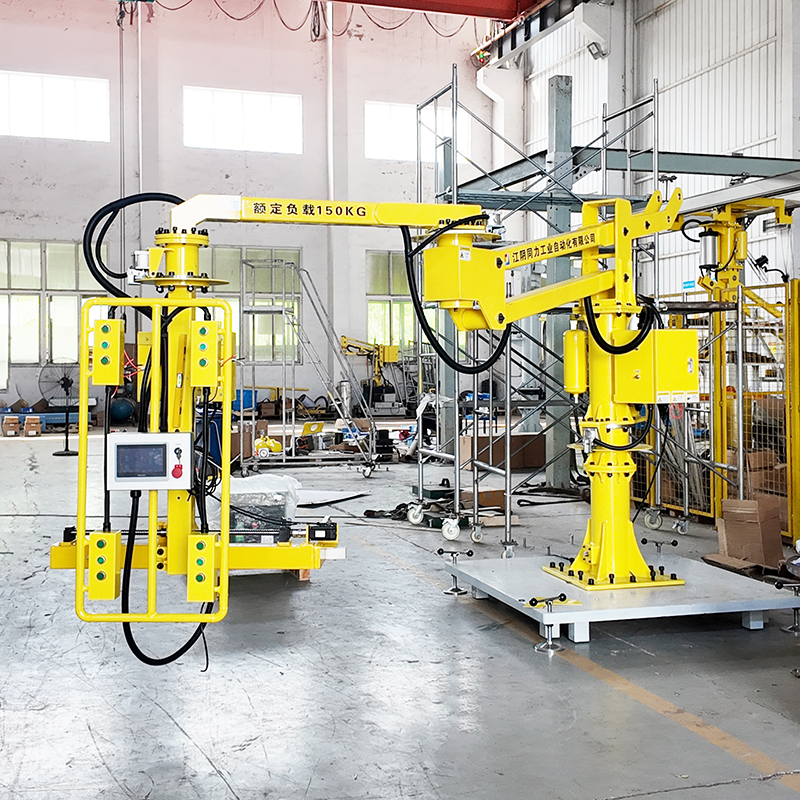
Mobile Lifting Device and Industrial Manipulator Technology
A mobile lifting device becomes significantly more versatile when combined with industrial manipulator technology.
An industrial manipulator is designed not only to lift a load but also to help the operator control its movement. Depending on the system configuration, the operator may be able to:
- Lift and lower the workpiece
- Move the load horizontally
- Rotate components
- Tilt products
- Turn awkward parts
- Position loads accurately
- Reach into machines or workstations
This is one of the key differences between a traditional lifting device and a manipulator-based lift-assist system.
A conventional hoist primarily focuses on vertical lifting. A pneumatic or electric manipulator can provide more controlled movement and greater positioning flexibility.
For complex material handling tasks, this combination can transform a simple mobile lifting device into a complete ergonomic handling solution.
Pneumatic Mobile Lifting Devices
A pneumatic mobile lifting device uses compressed air to generate lifting force and balance the workpiece.
Pneumatic manipulators are widely used in industrial material handling because they can provide smooth and responsive movement. When properly configured, the pneumatic balancing system can compensate for the weight of the load, allowing the operator to guide the workpiece with significantly less physical effort.
This near-weightless handling capability is particularly useful for repetitive operations.
A pneumatic mobile lifting device may be suitable for:
- Machine loading and unloading
- Assembly operations
- Roll handling
- Packaging
- Palletizing
- Automotive component handling
- Metal parts handling
- Container and drum handling
The pneumatic system can be integrated with a rigid arm or articulated arm structure, allowing the operator to move the load through the required working area.
A customized pneumatic manipulator can also be equipped with application-specific tooling to handle different product shapes and materials.
How a Pneumatic Manipulator Improves Mobile Material Handling
The main advantage of pneumatic manipulator technology is its ability to balance the load.
In a typical system, compressed air provides lifting force through a pneumatic balancing mechanism. The manipulator arm supports the weight of the workpiece while allowing the operator to control movement.
The operator does not need to physically carry the entire load.
Instead, the manipulator acts as a mechanical extension of the operator.
This creates several important benefits:
Reduced Physical Effort
Heavy lifting can place significant strain on workers. A mobile lifting device equipped with a pneumatic manipulator can reduce the amount of manual force required during repetitive operations.
Improved Ergonomics
Operators can move products without repeatedly bending, lifting, stretching, or carrying heavy loads manually.
Better Positioning Control
Rigid-arm manipulator systems can provide stable and controlled movement, making them suitable for positioning components into machines, fixtures, assembly stations, and packaging equipment.
Flexible Workstation Coverage
A mobile base allows the lifting device to be relocated when production requirements change.
Customized Handling
Different end effectors can be designed according to the workpiece and handling process.
Electric Mobile Lifting Devices
While pneumatic systems are widely used for industrial lift assistance, electric mobile lifting devices are another important solution for modern factories.
Electric lifting systems can use motors, servo technology, sensors, and intelligent control systems to provide controlled material movement.
An electric manipulator may be particularly suitable when manufacturers require:
- High positioning precision
- Controlled lifting speeds
- Repeatable movement
- Programmable functions
- Intelligent control
- Reduced dependence on compressed air
- Integration with automated equipment
Electric systems can also support mobile material handling applications where a facility needs a self-contained or battery-powered solution.
In flexible manufacturing environments, an electric mobile lifting device can provide a combination of mobility and precision.
Pneumatic vs. Electric Mobile Lifting Device
Both pneumatic and electric systems can provide effective lifting assistance. The best choice depends on the production environment and handling requirements.
Pneumatic Manipulator
A pneumatic solution is often preferred when operators need intuitive manual control and smooth load balancing.
Advantages include:
- Responsive movement
- Natural operator control
- Effective load balancing
- Suitable for repetitive handling
- Flexible customized tooling
- Strong suitability for ergonomic lift assistance
Electric Manipulator
An electric solution may be preferred when precision, control, and intelligent functions are especially important.
Advantages may include:
- Accurate positioning
- Programmable movement
- Controlled lifting speed
- Smart controls
- Data and diagnostic capabilities
- Potential integration with automated systems
For some applications, the ideal mobile lifting device may combine different technologies, such as electric movement with pneumatic gripping or balancing.
The system should always be selected based on the actual production process.
Customized End Effectors for Mobile Lifting Devices
The lifting arm itself is only one part of the handling system. The end effector is equally important.
A mobile lifting device can be equipped with different gripping tools depending on the workpiece.
Common options include:
Mechanical Grippers
Mechanical clamps can be used for solid, irregular, or specially shaped products.
Vacuum Suction Devices
Vacuum tooling can be suitable for certain cartons, panels, sheets, and other products with appropriate surface characteristics.
Magnetic Lifters
Magnetic end effectors can assist with handling suitable ferrous metal components.
Hooks and Custom Fixtures
Hooks, mandrels, forks, clamps, and specialized fixtures can be designed for unique industrial applications.
For example, rolls, coils, drums, automotive parts, containers, and machine components may all require different gripping solutions.
A customized manipulator system allows the mobile lifting device to be matched to the actual shape, weight, center of gravity, and movement requirements of the workpiece.
Common Applications of Mobile Lifting Devices
Manufacturing and Assembly
Heavy components often need to be positioned accurately during assembly.
A mobile lifting device can support the weight of the component while allowing the operator to guide it into position.
Machine Loading and Unloading
Operators may need to move heavy parts into CNC machines, presses, processing equipment, or other production systems.
A manipulator-based lifting device can improve access and positioning.
Warehouse and Internal Logistics
Mobile lifting equipment can assist with transferring products between pallets, carts, conveyors, and workstations.
Roll and Coil Handling
Paper, film, textile, foil, and other industrial rolls can be difficult to lift manually.
A manipulator with a customized roll-handling tool can improve control during lifting, rotation, and positioning.
Packaging Operations
Boxes, containers, bags, and packaged products may require repetitive handling throughout the production process.
A mobile lift-assist system can help reduce manual handling demands.
How to Choose the Right Mobile Lifting Device
Selecting the right mobile lifting device requires more than simply determining the load weight.
Manufacturers should evaluate several important factors.
Load Capacity
The system must be designed for the maximum workpiece weight, including the weight of the gripping tool.
Working Range
Consider how far the load must move horizontally and vertically.
Required Movement
Determine whether the application requires lifting only or additional movement such as rotation, tilting, turning, or precise positioning.
Workpiece Characteristics
Important considerations include:
- Weight
- Dimensions
- Shape
- Surface material
- Center of gravity
- Fragility
- Temperature
Power Source
The production environment may influence whether pneumatic or electric technology is the better choice.
Mobility Requirements
Consider how frequently the equipment needs to move between workstations and whether the floor layout provides sufficient space for mobile operation.
End Effector Design
The gripping tool should be designed specifically for safe and reliable handling of the product.
Improving Factory Flexibility with Mobile Lift Assist Equipment
Manufacturing environments are becoming increasingly flexible.
Production lines may need to handle different product sizes, changing order volumes, and frequent workstation adjustments.
A fixed lifting system may not always provide the required flexibility.
A mobile lifting device offers an alternative approach by allowing lifting assistance to be moved closer to where it is needed.
When combined with pneumatic or electric manipulator technology, the equipment can provide both mobility and precise handling capability.
Instead of forcing the operator to adapt to the lifting equipment, the lifting system can be designed around the operator and the production process.
This human-centered approach can improve efficiency while maintaining flexibility.
Safety Considerations
Safety is an important part of every mobile lifting device design.
Key considerations include:
- Correct load capacity
- Secure end effector design
- Stable mobile base
- Reliable braking or positioning systems
- Load retention protection
- Emergency stop functions
- Proper operator controls
- Regular maintenance
- Operator training
The equipment should also be designed according to the specific requirements of the application and applicable workplace safety standards.
Conclusion
A mobile lifting device provides manufacturers with a flexible solution for lifting and handling materials in changing industrial environments.
When combined with a pneumatic manipulator, the system can provide smooth, balanced, and ergonomic handling for heavy or awkward workpieces. When combined with electric manipulator technology, it can provide precise movement and intelligent control.
The right solution depends on the workpiece, payload, working range, required movement, production environment, and mobility requirements.
For manufacturers looking to improve ergonomic material handling, reduce manual lifting, and increase operational flexibility, a customized mobile lifting device based on pneumatic or electric manipulator technology can provide an efficient and practical solution.
With the right lifting arm, balancing system, mobile structure, and customized end effector, a mobile lift-assist system can become an important part of a modern material handling strategy.
Explore customized industrial manipulator and material handling solutions designed to support efficient, ergonomic, and flexible lifting operations across a wide range of manufacturing applications.
Post time: Sep-10-2026