

As manufacturing processes become more flexible and product handling requirements become increasingly complex, traditional lifting equipment is no longer sufficient for every industrial application. Heavy components, irregularly shaped workpieces, fragile products, and repetitive lifting tasks all require better control, greater flexibility, and improved operator ergonomics.
This is where manipulator lifting equipment provides an effective solution.
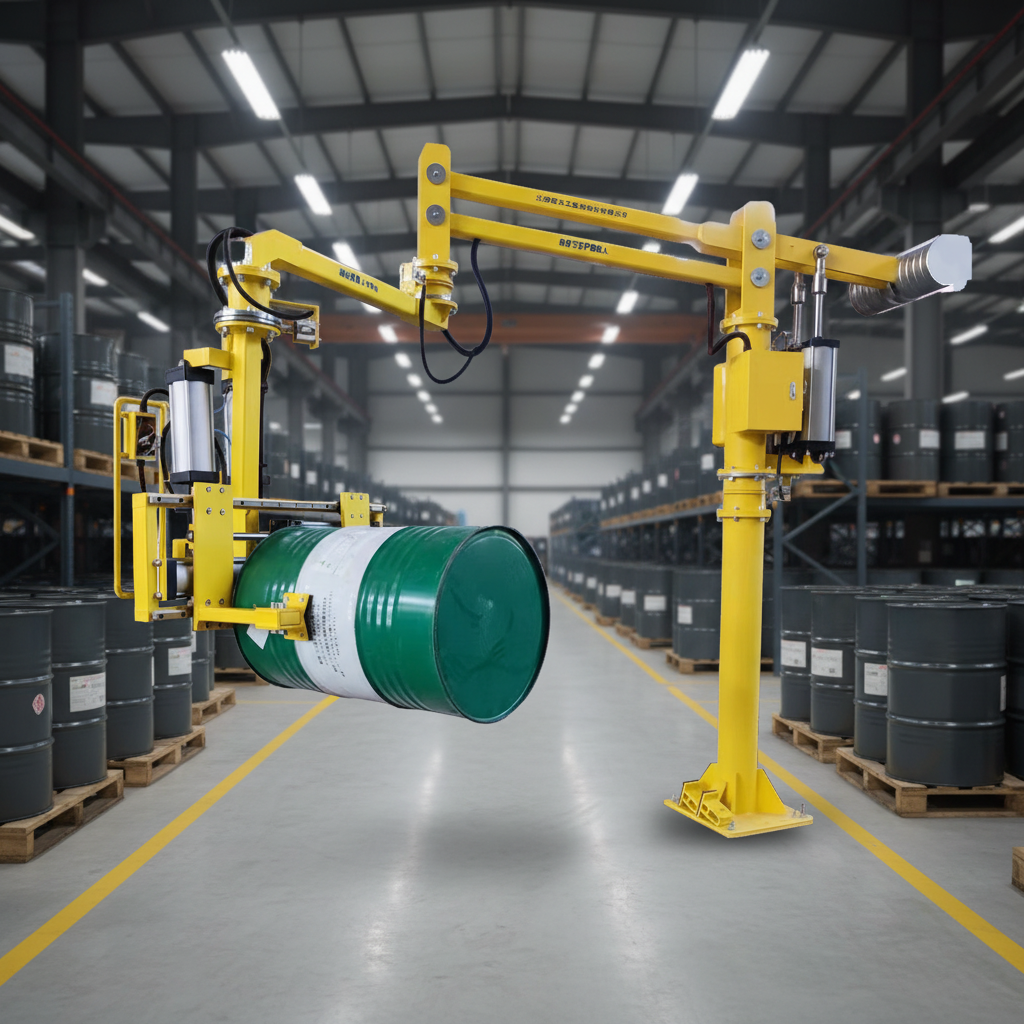
Unlike conventional cranes and hoists that are mainly designed to lift and transport loads, manipulator lifting equipment combines a mechanical arm, lifting mechanism, control system, and customized end effector to help operators lift, move, rotate, tilt, and accurately position industrial workpieces.
For factories looking to reduce manual handling while maintaining operator involvement, manipulator-based lifting equipment offers a practical bridge between conventional lifting and full automation.
What Is Manipulator Lifting Equipment?
Manipulator lifting equipment is a type of industrial material handling system designed to assist workers in handling loads that may be too heavy, bulky, repetitive, or difficult to position manually.
A typical system consists of several key components:
- Manipulator arm
- Lifting or balancing mechanism
- Pneumatic or electric power system
- Operator control handle
- Customized end-of-arm tooling
- Safety and load protection system
- Supporting structure or mounting base
The equipment can be configured according to the weight, dimensions, center of gravity, surface characteristics, and required movement of the workpiece.
This makes manipulator lifting equipment different from standard lifting machinery. Instead of simply moving a load from point A to point B, the manipulator is designed around the complete handling process.
Why Choose Manipulator Lifting Equipment?
Manual lifting can become inefficient when workers repeatedly handle heavy components throughout a production shift. At the same time, a conventional crane may not provide the positioning flexibility required for detailed assembly or machine-loading operations.
Manipulator lifting equipment fills this gap.
The operator remains directly involved in the handling process, but the equipment provides the lifting force and mechanical support.
This can help manufacturers achieve several objectives:
Reduced Manual Lifting
The manipulator supports the weight of the workpiece, reducing the physical force required from the operator.
Improved Ergonomics
Operators can handle heavy or awkward products with less bending, carrying, and repetitive physical effort.
More Accurate Positioning
The articulated arm or rigid arm structure allows the operator to guide a workpiece into a specific position.
Faster Handling
Smooth and responsive movement can reduce unnecessary handling steps between workstations.
Flexible Production
A customized manipulator can be adapted to different production processes, workpiece dimensions, and tooling requirements.
Pneumatic Manipulator Lifting Equipment
Pneumatic technology is one of the most widely used approaches for manipulator lifting equipment.
A pneumatic manipulator uses compressed air to generate lifting force and balance the load. When the system is correctly configured, the lifting force can closely compensate for the weight of the workpiece.
This allows an operator to guide the load with relatively little physical effort.
For suitable applications, pneumatic balancing can create a near-weightless handling effect.
A pneumatic lift manipulator typically combines a pneumatic cylinder, rigid arm structure, control valve, and end effector. The arm may maintain the orientation of the load while the operator controls its movement.
This type of system is especially useful for repetitive industrial handling operations where workers need to pick up, move, and position the same type of component many times.
Electric Manipulator Lifting Equipment
Electric technology provides another approach for industrial lifting applications.
An electric manipulator can use motors, electric hoists, sensors, and control systems to provide controlled lifting and positioning.
Electric systems can be particularly useful when the application requires:
- Precise positioning
- Controlled lifting speed
- Repeatable movements
- Higher levels of automation
- Integration with production equipment
- Programmable operation
Electric lifting equipment can also be integrated with customized arms and tooling to create a specialized handling system.
For manufacturers without a convenient compressed-air supply, an electric solution may provide greater installation flexibility.
The choice between pneumatic and electric technology should therefore be based on the actual production environment rather than simply the load capacity.
Rigid Arm vs. Flexible Handling
Different workpieces require different types of movement.
A rigid arm manipulator provides stable and controlled movement and can be particularly useful when the orientation of the workpiece needs to remain consistent during lifting.
For applications requiring more freedom of movement, articulated manipulator designs can provide additional flexibility.
The structure can be selected according to factors such as:
- Required working radius
- Vertical lifting distance
- Horizontal reach
- Workpiece dimensions
- Load center of gravity
- Required rotation
- Available floor space
The goal is not simply to select the largest lifting machine. The objective is to create a manipulator system that matches the actual motion required by the production process.
Customized End Effectors Make the Difference
One of the most important components of manipulator lifting equipment is the end effector.
The lifting arm provides the movement, but the end effector determines how the workpiece is actually held.
Different applications may require:
Vacuum Grippers
Vacuum suction tooling can be used for suitable flat, smooth, or non-porous surfaces such as panels, glass, cartons, and certain sheet materials.
Mechanical Clamps
Clamps can provide a secure grip on components with suitable edges, holes, surfaces, or structural features.
Magnetic Tools
Magnetic lifting devices can be designed for compatible ferrous metal workpieces.
Hooks and Mandrels
Hooks, shafts, mandrels, and specialized fixtures can be used for rolls, coils, containers, and other industrial products.
Customized Grippers
For unusual workpieces, a dedicated gripper can be engineered around the product geometry and handling process.
This customization capability is one of the major advantages of manipulator lifting equipment.
Applications Across Modern Manufacturing
Manipulator lifting equipment can be applied across a wide range of industries.
Automotive Manufacturing
Automotive components such as wheels, engines, doors, batteries, and structural parts can require repetitive lifting and positioning.
A manipulator can support these operations while allowing workers to maintain direct control.
Metal Processing
Heavy metal components, fabricated parts, sheets, and assemblies can be difficult to handle manually.
Customized lifting tools can make these operations more efficient.
Glass and Panel Handling
Glass panels and other large surfaces require controlled movement because damage can occur if the product is improperly handled.
Vacuum-based manipulator tooling can provide a suitable handling method for compatible products.
Roll and Coil Handling
Industrial rolls can be heavy and difficult to rotate or position manually.
A manipulator equipped with a customized mandrel or gripping system can assist with lifting, turning, and positioning rolls.
Packaging and Logistics
Boxes, bags, containers, and packaged products may need to be transferred repeatedly between pallets, conveyors, and workstations.
Manipulator lifting equipment can reduce repetitive manual handling.
Machine Loading and Unloading
Operators frequently need to load heavy workpieces into CNC machines, presses, furnaces, and other processing equipment.
A manipulator can provide controlled movement while reducing the physical effort required.
Manipulator Lifting Equipment vs. Traditional Hoists
Traditional hoists remain useful for many lifting applications, particularly when the main requirement is vertical movement.
However, a manipulator provides additional functionality.
A hoist generally suspends a load from a cable or chain. The operator then controls the load separately.
A manipulator, in contrast, provides a structured mechanical arm that supports and guides the workpiece.
This difference becomes important when an application requires:
- Horizontal positioning
- Precise placement
- Rotation or tilting
- Ergonomic operator control
- Repetitive pick-and-place operations
- Customized gripping
Therefore, manipulator lifting equipment is not necessarily a replacement for every crane or hoist. Instead, it is a specialized solution for applications where controlled and ergonomic load manipulation is required.
How to Select the Right Manipulator Lifting Equipment
Before purchasing or designing a manipulator, manufacturers should evaluate the complete handling process.
1. Determine the Maximum Load
Calculate the maximum weight of the workpiece and include the weight of the end effector.
2. Analyze the Workpiece
Consider dimensions, shape, surface material, center of gravity, and fragility.
3. Define the Required Movement
Determine whether the operator needs lifting, lowering, horizontal movement, rotation, tilting, or multi-directional positioning.
4. Select the Power System
Pneumatic systems are suitable for many balanced manual handling applications, while electric systems can be advantageous when precision, programmability, or electrical integration is required.
5. Design the End Effector
The gripping system should match the product rather than being treated as a standard accessory.
6. Evaluate the Workspace
Arm reach, ceiling height, machine layout, aisle width, and operator position all influence the final design.
The Future of Industrial Lifting
Modern factories are moving toward a production model that combines automation with human flexibility.
Fully automated robots are highly effective for repetitive and predictable processes, but not every material handling task is suitable for complete automation.
This is where manipulator lifting equipment becomes increasingly valuable.
A manipulator allows the operator to make decisions and guide the load while the machine supplies the necessary lifting force and mechanical support.
The result is a practical form of human-machine collaboration.
For manufacturers, this can provide a balance between automation investment, operational flexibility, productivity, and worker ergonomics.
Conclusion
Manipulator lifting equipment is becoming an important solution for manufacturers that need more than basic lifting capability.
By combining pneumatic or electric lifting technology with mechanical arms, intelligent controls, and customized end effectors, manufacturers can create handling systems designed around their specific production requirements.
From automotive components and metal parts to glass, rolls, panels, boxes, and machine components, manipulator systems can support a wide range of industrial handling applications.
The right solution depends on the workpiece, load capacity, required movement, working environment, and production objectives.
For companies seeking to reduce manual lifting, improve ergonomic working conditions, and achieve more controlled material handling, customized manipulator lifting equipment can provide a flexible and efficient solution for modern manufacturing.
Tongli focuses on industrial handling and automation solutions, including pneumatic manipulators, rigid arm manipulators, wire rope manipulators, balanced cranes, vacuum tube lifters, and electric hoist manipulators. The equipment can be configured with application-specific lifting and gripping tools to meet different industrial handling requirements.
Post time: Sep-14-2026