

Modern manufacturing facilities face increasing demands for production efficiency, workplace safety, and flexible material handling. In many industrial environments, operators still need to lift, rotate, transfer, and position heavy or awkward workpieces repeatedly throughout the day. These tasks can increase physical fatigue, slow down production, and create ergonomic challenges.
Industrial ergonomic manipulators provide a practical solution by combining mechanical lifting assistance, controlled movement, and customized gripping tools. They help operators handle industrial components with less physical effort while maintaining control over the positioning process.
For manufacturers looking to improve workstation ergonomics without completely replacing manual operations with fully automated systems, industrial manipulators offer a flexible and efficient approach.
What Are Industrial Ergonomic Manipulators?
Industrial ergonomic manipulators are specialized material handling devices designed to reduce the physical demands of lifting, moving, and positioning workpieces in manufacturing environments.
Unlike conventional lifting equipment that primarily raises and lowers loads, an industrial ergonomic manipulator can support multiple handling movements, depending on its configuration. These may include lifting, lowering, horizontal movement, rotation, tilting, and precise positioning.
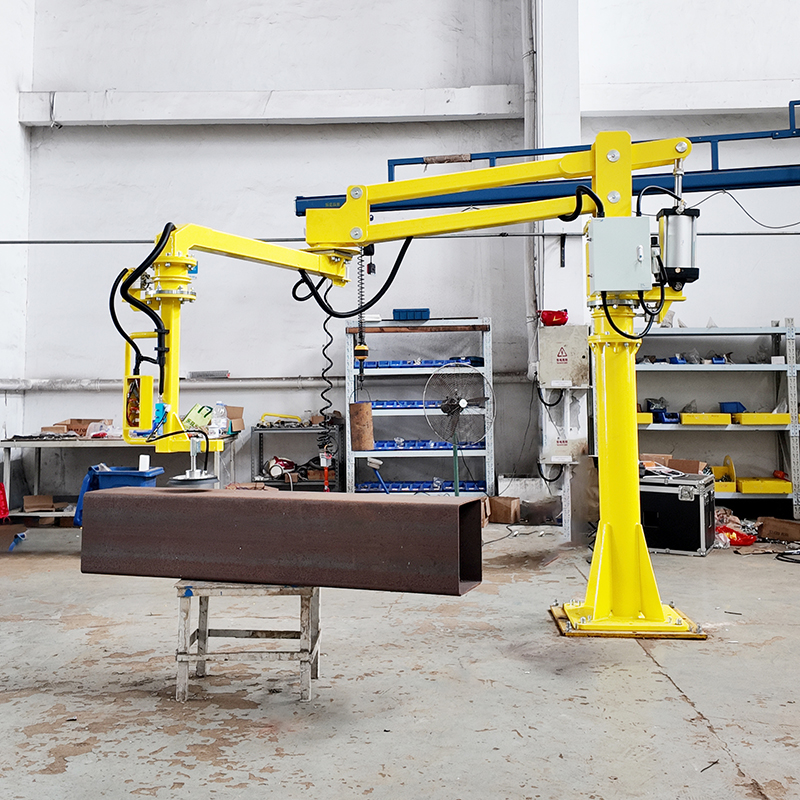
A typical system consists of a supporting structure, a mechanical arm, a lifting or balancing mechanism, a control handle, and an application-specific end effector.
Depending on the application, the equipment may use pneumatic or electric technology. Customized tooling can include vacuum suction cups, mechanical clamps, gripping fixtures, or specialized handling devices designed for particular products.
Tongli provides industrial handling solutions for different workpieces and production requirements. Explore our industrial manipulator solutions to learn more about possible material handling configurations.
Key Benefits of Industrial Ergonomic Manipulators
1. Reduce Manual Lifting and Physical Strain
Repeated manual handling can place significant demands on workers, particularly when products are heavy, bulky, or difficult to grip.
Industrial ergonomic manipulators support the weight of workpieces during lifting and movement. This reduces the physical force operators need to apply and can help minimize repetitive bending, stretching, and manual carrying.
By improving the ergonomics of individual workstations, manufacturers can create more manageable handling processes for repetitive production tasks.
2. Improve Material Handling Efficiency
Manual handling can become a production bottleneck when operators must repeatedly lift products, adjust their positions, or coordinate with other workers.
An ergonomic manipulator helps streamline these movements by providing controlled lifting and positioning assistance. With an appropriate working radius and customized end effector, operators can transfer workpieces between machines, conveyors, fixtures, and assembly stations more efficiently.
The actual productivity improvement depends on the workpiece, handling cycle, workstation layout, and equipment configuration.
3. Enable Controlled and Accurate Positioning
Some industrial components require more than simple vertical lifting. They may need to be aligned with a fixture, inserted into a machine, or rotated into a specific orientation.
Industrial manipulators can provide controlled movement throughout the required handling range. Rigid-arm configurations can also offer more stable positioning than freely suspended loads in suitable applications.
This is particularly valuable for precision assembly, machine loading and unloading, and handling components that could be damaged by uncontrolled movement.
4. Protect Products During Handling
Different workpieces require different gripping methods. Metal components may need mechanical clamps, while smooth panels or suitable packaging materials may be handled with vacuum suction tools.
A customized end effector helps distribute gripping forces appropriately and maintain a secure hold during movement.
Correct tooling selection is essential when handling fragile, finished, irregularly shaped, or surface-sensitive products.
5. Support Flexible Manufacturing
Industrial ergonomic manipulators can be configured for specific workstations and production processes. Depending on the design, they can be installed on floor-mounted columns, overhead structures, or other suitable support systems.
This flexibility makes them useful in factories where production layouts, product dimensions, and handling requirements vary between workstations.
Common Applications of Industrial Ergonomic Manipulators
Automotive Manufacturing
Automotive production involves repetitive handling of doors, tires, metal components, interior assemblies, and other parts.
An industrial ergonomic manipulator equipped with suitable clamps or gripping fixtures can help operators lift and position these components during assembly. This reduces manual handling demands and supports consistent component placement.
Machine Loading and Unloading
CNC machines, presses, and other industrial equipment often require workpieces to be loaded and removed repeatedly.
A manipulator can assist operators in transferring components between storage areas, conveyors, and processing equipment. The lifting capacity, arm reach, and tooling should be selected according to the machine layout and workpiece characteristics.
Metal Fabrication and Sheet Handling
Metal sheets, fabricated components, and heavy industrial parts can be difficult to handle manually, especially when they have sharp edges, large dimensions, or uneven weight distribution.
Vacuum lifting tools, mechanical clamps, and customized gripping systems can provide more controlled handling when designed for the specific material and surface conditions.
Packaging and Palletizing
Packaging operations frequently involve repetitive movement of cartons, bags, containers, and other products.
Industrial ergonomic manipulators can assist with transferring products between conveyors, packing stations, and pallets. They can also be configured for selected lifting, turning, and stacking operations.
Roll and Coil Handling
Paper rolls, plastic film rolls, textile rolls, and metal coils may be heavy and difficult to rotate or position accurately.
A dedicated roll handling manipulator can use an appropriate gripping mechanism to support lifting, turning, and placement. The tooling should account for the roll diameter, width, weight, core structure, and required orientation.
Types of Industrial Ergonomic Manipulators
Different industrial applications require different lifting technologies and mechanical configurations.
Pneumatic Ergonomic Manipulators
Pneumatic manipulators use compressed air to provide lifting assistance or load balancing. In suitable configurations, the operator can guide the workpiece smoothly with minimal physical effort.
They are often considered for repetitive handling, assembly operations, machine tending, and applications requiring responsive operator control.
Learn more about our pneumatic manipulator solutions.
Electric Ergonomic Manipulators
Electric manipulators use electrically powered lifting or motion systems to support controlled material handling.
Depending on the design, they can offer adjustable movement speeds, precise positioning, and integration options for more demanding handling processes.
They may be suitable for applications requiring consistent motion control or specific electrical control functions.
Vacuum Lifting Manipulators
Vacuum lifting manipulators use suction tools to grip compatible surfaces. They can be configured for handling panels, sheets, containers, and selected packaged products.
The vacuum system must be designed around the workpiece surface, porosity, weight, dimensions, and required safety measures.
Customized Industrial Manipulators
Some products cannot be handled effectively with standard gripping equipment. Irregular shapes, special lifting points, sensitive surfaces, and restricted working spaces may require a customized solution.
A purpose-designed industrial manipulator can combine an appropriate arm structure, lifting mechanism, and end effector to match the actual production process.
How to Choose the Right Industrial Ergonomic Manipulator
Selecting the right equipment requires an understanding of both the workpiece and the operating environment.
Payload capacity: Calculate the workpiece weight and account for the end effector and other supported tooling according to the manufacturer’s rated-capacity requirements.
Working radius and lifting stroke: Confirm that the equipment can reach every required pickup and placement position without interfering with surrounding machinery.
Workpiece characteristics: Evaluate the product’s dimensions, center of gravity, surface condition, shape, and fragility.
Required movements: Determine whether the process requires vertical lifting, horizontal transfer, rotation, tilting, or precise alignment.
Gripping method: Choose between vacuum suction, mechanical clamping, specialized fixtures, or other suitable tooling.
Installation and utilities: Consider available floor space, mounting conditions, compressed-air supply, electrical requirements, and production-line integration.
Safety requirements: Review load retention, overload protection, emergency procedures, operator access, and other safeguards appropriate to the application.
A detailed assessment of these factors helps ensure that the manipulator matches the production task rather than simply meeting the nominal load requirement.
Why Choose a Customized Industrial Ergonomic Manipulator?
A standard lifting device may not fully address every industrial handling challenge. Customized industrial ergonomic manipulators allow manufacturers to adapt the handling mechanism to the workpiece, workstation, and production workflow.
Tongli Industrial focuses on material handling equipment and customized automation solutions for different industrial requirements. By evaluating the workpiece, handling cycle, and installation environment, manufacturers can identify a suitable combination of arm structure, lifting technology, and end-of-arm tooling.
The objective is to create a practical handling solution that supports operator ergonomics, controlled product movement, and efficient production workflows.
Conclusion
Industrial ergonomic manipulators play an important role in modern manufacturing by helping reduce manual lifting demands, improve material handling control, and support more efficient workstation operations.
From automotive assembly and machine tending to metal fabrication, packaging, and roll handling, the right manipulator can make repetitive handling tasks easier to manage.
The most suitable solution depends on the payload, working radius, required movements, gripping method, and factory layout. By selecting equipment around actual production requirements, manufacturers can improve workplace ergonomics while maintaining the flexibility of operator-assisted material handling.
Contact Tongli to discuss a customized industrial manipulator for your application.
Post time: Oct-16-2026