

Modern manufacturing facilities increasingly rely on automation to improve production efficiency, maintain consistent handling quality, and reduce repetitive manual operations. A gantry robot system is an effective solution for factories that need to transfer workpieces across defined working areas, connect multiple production stations, or automate machine loading and unloading.
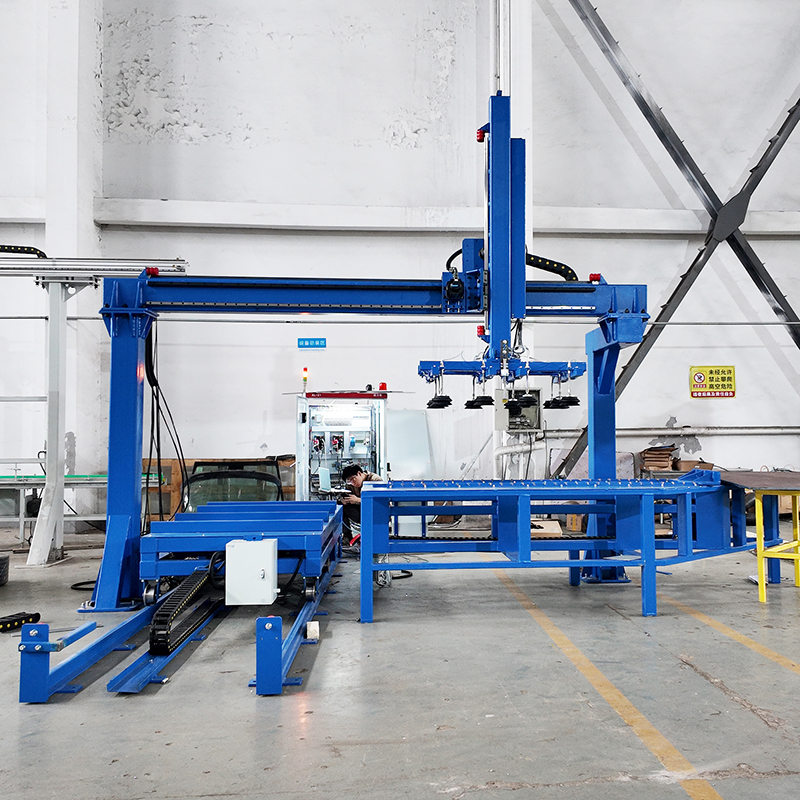
As shown in this industrial gantry robot installation, a rigid overhead frame, horizontal travel mechanism, vertical lifting axis, and vacuum gripping device work together to handle materials within a dedicated production area. With a suitable end effector and customized control system, this type of automation equipment can be adapted to different workpieces and manufacturing processes.
What Is a Gantry Robot System?
A gantry robot is an industrial automation system that moves a tool or workpiece along linear axes, typically X, Y, and Z. Unlike a conventional articulated robot that moves through rotating joints, a Cartesian gantry robot uses linear motion to cover a defined rectangular working envelope.
A typical gantry robot system consists of a structural frame, linear guides, drive mechanisms, a vertical lifting unit, an end-of-arm tool, and an electrical control system. Depending on the application, servo motors, sensors, safety devices, conveyors, and machine interfaces can also be integrated.
This configuration allows manufacturers to automate repetitive transfer operations while maintaining a predictable movement path. The frame dimensions, travel distance, payload capacity, and gripping method can be engineered according to the actual production requirements.
Key Components of an Automated Gantry Handling System
1. Rigid Gantry Frame
The gantry frame supports the moving mechanism and establishes the robot’s working envelope. Its structure must be designed according to the required payload, travel distance, acceleration, and operating conditions.
A properly engineered frame helps maintain mechanical stability and supports consistent positioning during repetitive material handling operations.
2. Horizontal and Vertical Motion Axes
The horizontal axis moves the handling unit between pickup and delivery positions, while the vertical axis raises and lowers the end effector.
For applications requiring additional positioning flexibility, a system can incorporate a cross-travel axis or a rotating tool. The number of axes and their specifications should match the actual handling path rather than simply maximizing the number of movements.
3. Vacuum Gripping Device
The pictured installation uses multiple vacuum suction cups as the gripping interface. Vacuum grippers can be suitable for flat, nonporous materials such as glass panels, metal sheets, and selected board materials.
The suction cup arrangement should be determined by the workpiece’s dimensions, surface condition, weight, center of gravity, and deformation characteristics. Vacuum pressure monitoring and appropriate safety measures are also important when handling heavy or valuable materials.
For porous, uneven, or irregular workpieces, alternative gripping methods may be more appropriate.
4. Conveyor and Workstation Integration
A gantry robot can operate alongside conveyors, loading tables, processing machines, or dedicated fixtures. These components establish repeatable pickup and placement positions and help connect separate production operations.
Sensors and PLC-based controls can coordinate material availability, machine status, and robot movements, allowing the system to operate as part of a larger automated production line.
Main Applications of Gantry Robots in Manufacturing
Automated Machine Loading and Unloading
Gantry robots can load raw materials into processing equipment and remove finished workpieces after machining or processing is complete. Typical applications include CNC machine tending, laser cutting, stamping, and other repetitive production operations.
Automating these tasks can reduce manual handling and help maintain a more consistent production rhythm.
Sheet Material and Panel Handling
Large or flat workpieces can be difficult to lift, reposition, and align manually. A gantry handling robot equipped with a suitable vacuum gripping system can transfer compatible sheets or panels between storage racks, conveyors, and processing stations.
The gripping configuration must be matched to the material and surface properties to ensure reliable handling.
Assembly Line Material Transfer
In assembly operations, a gantry robot can move components between fixtures, inspection stations, and assembly equipment. Its defined linear travel path can be useful when pickup and placement positions are arranged along a production line.
Customized tooling and motion sequences allow the system to accommodate different component sizes and process requirements.
Automated Production Line Integration
A gantry robot system can be designed to serve one workstation or multiple stations within a larger production area. When integrated with conveyors, sensors, and machine controls, it can reduce unnecessary material movement and improve coordination between manufacturing processes.
The final configuration depends on cycle time, station spacing, production volume, and the availability of intermediate storage positions.
Benefits of Using a Customized Gantry Robot System
Improved handling efficiency: Automated travel and lifting reduce the time spent on repetitive transfer tasks and can help stabilize production workflows.
Consistent positioning: Programmed motion paths and properly designed fixtures support repeatable pickup and placement operations.
Reduced manual handling: Automating suitable lifting and transfer tasks can reduce workers’ exposure to repetitive physical effort and awkward material movements.
Flexible working envelope: The gantry structure can be engineered for different travel distances, workstation layouts, and material transfer requirements.
Integration with existing equipment: Customized systems can be developed around existing conveyors, processing machines, and production stations, subject to layout and interface compatibility.
Actual productivity improvements depend on the application, equipment configuration, production cycle, and integration quality.
How to Select the Right Gantry Robot for Your Application
Choosing a suitable gantry robot begins with understanding the material and the production process.
Payload and workpiece dimensions: Identify the maximum load weight, product size, center of gravity, and surface characteristics. Include the end effector’s weight when calculating the required robot payload.
Working range: Define the required X-, Y-, and Z-axis travel distances, including pickup and placement positions, machine clearances, and maintenance access.
Gripping method: Select vacuum suction cups, mechanical grippers, clamps, or other tooling according to the workpiece’s shape and handling requirements.
Cycle time: Establish the target handling frequency and consider acceleration, lifting distance, gripping time, and communication with other equipment.
Production environment: Evaluate floor space, installation height, dust, temperature, and other operating conditions that may affect equipment design.
Safety and controls: Consider guarding, safety sensors, emergency stops, load retention, and communication with connected machines. The complete system should be assessed according to its intended operating conditions and applicable safety requirements.
Providing these details early helps an automation supplier develop a more practical and cost-effective solution.
Customized Gantry Robot Solutions from Tongli
Every production line has different handling challenges. Jiangyin Tongli Industrial Co., Ltd. develops industrial automation and material handling equipment designed around specific manufacturing requirements.
Depending on the application, a customized gantry robot solution can incorporate a suitable structural frame, linear motion axes, lifting mechanism, vacuum gripping device, conveyor interface, and coordinated control system.
Whether the objective is to automate machine loading and unloading, transfer sheet materials, or connect multiple production stations, the system design should begin with the actual workpiece, working envelope, and production process.
Explore our gantry robot solutions to learn more about available configurations and industrial applications.
If you are planning a new automation project, prepare your workpiece dimensions, maximum payload, required travel distance, target cycle time, and production layout. These details will help determine whether a standard configuration or a customized gantry handling system is the better fit.
Frequently Asked Questions
What materials can a gantry robot handle?
A gantry robot can handle many types of industrial workpieces, including metal sheets, panels, machine components, and packaged products. The suitable application depends on the payload, workpiece geometry, gripping method, and operating environment.
What is the difference between a gantry robot and an articulated robot?
A gantry robot primarily uses linear axes to move within a defined working envelope. An articulated robot uses rotary joints to provide more flexible movement. Gantry systems are often considered for long linear travel, overhead handling, and structured multi-station layouts, while articulated robots can be advantageous for complex movements and varied orientations.
Can a gantry robot use vacuum suction cups?
Yes. Vacuum suction cups can be integrated when the workpiece surface and material properties are suitable. Cup layout, vacuum supply, load distribution, and vacuum-loss protection should be evaluated during system design.
Can a gantry robot be integrated into an existing production line?
Yes, in many applications. Integration requires checking available installation space, machine interfaces, material flow, cycle time, electrical controls, and safety requirements. The final design depends on the existing equipment and production process.
How do I choose a suitable gantry robot system?
Start by defining the workpiece weight and dimensions, required travel range, gripping method, target cycle time, production layout, and environmental conditions. An automation supplier can use this information to assess the appropriate system configuration.
Conclusion
A gantry robot system offers a practical approach to automating repetitive material handling, machine tending, and production line transfer operations. By combining a suitable frame structure, linear motion axes, application-specific gripping tools, and coordinated controls, manufacturers can build an automation solution around their actual production needs.
The key to successful implementation is not simply selecting a robot, but designing the complete handling process around the workpiece, working range, cycle time, and factory layout.
Post time: Oct-13-2026