

Modern manufacturing and logistics demands fast, precise, and ergonomic material handling. As production lines become more automated and workplace safety standards grow stricter, plant managers and operational engineers face the ongoing challenge of moving heavy, awkward, or delicate workpieces efficiently.
A floor mounted manipulator offers a rigid, self-supporting lift solution that bridges the gap between purely manual lifting and high-cost fully automated robotics. Designed to anchor directly into a facility’s concrete foundation, these industrial manipulators provide maximum stability and 360-degree rotational coverage without relying on overhead crane structures or ceiling capacity.
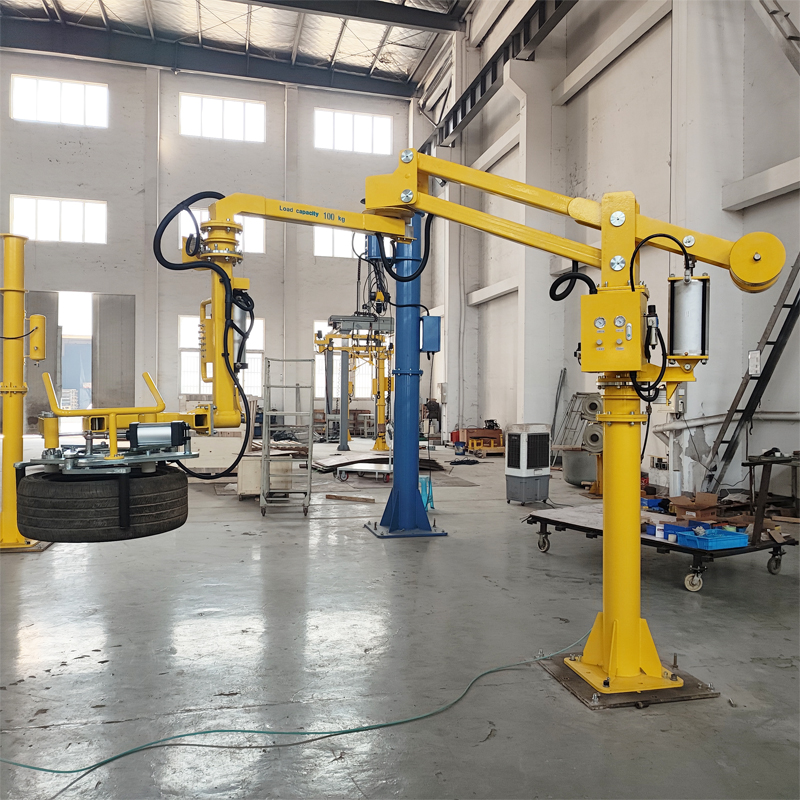
What is a Floor Mounted Manipulator?
A floor mounted manipulator—also referred to as a column-mounted industrial manipulator or rigid-arm lift assist—is a fixed-base pneumatic or electric material handling system. Unlike overhead rail-mounted systems or portable lift carts, the column of a floor mounted unit is securely bolted to the shop floor using high-strength expansion bolts or direct plate anchoring.
Equipped with rigid articulated arms and customized end-effectors (grippers, vacuum suction cups, pneumatic clamps, or mechanical hooks), these units counterbalance payloads, making heavy parts feel virtually weightless to operators.
Key Technical Specifications Overview
| Parameter | Standard Range / Capability |
| Payload Capacity | 30 kg to 600+ kg (depending on arm radius) |
| Working Radius | 1,500 mm to 4,500 mm (customizable) |
| Vertical Stroke | 1,000 mm to 2,500 mm |
| Rotation Angle | 360° continuous or limited-stop rotation |
| Drive Type | Pneumatic (Compressed Air, ~0.6 MPa) / Servo-Electric |
| Mounting Base | Heavy-duty steel baseplate fixed to concrete floor |
Key Technical Advantages for Industrial Operations
Investing in a high-performance floor-mounted manipulator system delivers measurable operational advantages across several manufacturing metrics:
1. Structural Independence
Ceiling trusses and overhead crane runways in older or modular facilities often lack the load-bearing capacity to support overhead track systems. A floor-mounted design transfers all static and dynamic loads directly to the building slab, eliminating costly structural ceiling retrofits or engineering surveys.
2. High Stability and Rigid Guidance
When handling off-center loads, high-torque workpieces, or operations that require precise part tilting/flipping, flexible cable hoists can sway or rotate unpredictably. The rigid articulated arms of a floor-mounted pneumatic manipulator eliminate pendulum motion, ensuring precise placement during assembly operations.
3. Operator Safety and Ergonomics
Repetitive manual lifting of items over 15–20 kg accounts for a significant portion of workplace musculoskeletal disorders (MSDs). Industrial manipulators handle 100% of the payload weight, keeping operator physical exertion minimal while maintaining intuitive manual control.
4. Tailored End-Effectors (Grippers)
Every workpiece geometry demands custom handling. Systems can be fitted with specialized tooling, including:
-
Pneumatic Vacuum Grippers: Ideal for sheet metal, glass panels, plastic boards, and sealed boxes.
-
Mechanical Clamping Jaws: Engineered for shafts, castings, drums, and automotive engine blocks.
-
Pneumatic Roll Inverters/Pitching Units: Designed to grab coils or rolls vertically and rotate them 90 degrees horizontally.
Common Industrial Applications
Floor-mounted industrial arms serve diverse manufacturing and packaging environments:
-
Automotive Assembly: Positioning engine blocks, transmissions, windshields, tires, and battery modules into chassis lines.
-
Sheet Metal & Fabrication: Loading heavy metal plates into CNC laser cutters, press brakes, or punch presses.
-
Packaging & Logistics: Palletizing corrugated boxes, drums, kegs, and industrial sacks onto shipping pallets.
-
Chemical & Pharmaceutical: Lifting sealed raw material drums or process vessels in regulated cleanroom spaces.
Key Considerations Before Selection
When choosing a floor mounted manipulator manufacturer for your facility, evaluate the following parameters:
-
Floor Slab Quality: Ensure your factory floor meets the minimum concrete depth and compression strength requirements (typically at least 150–200 mm of reinforced concrete).
-
Duty Cycle and Power Supply: Determine if fully pneumatic control (safe for explosive/ATEX environments) or electric-servo assistance (preferred for ultra-fast or variable-speed precision positioning) fits your workflow.
-
Reach vs. Clearance: Measure surrounding equipment heights, overhead piping, and structural columns to confirm the unit’s articulated arm rotation clearance.
Summary
Integrating a floor mounted manipulator into your assembly line or warehouse is a high-return investment that improves throughput, reduces product damage, and upholds strict ergonomic safety standards.
Post time: Aug-17-2026