

Automotive manufacturing requires precise component handling, consistent assembly quality, and efficient production workflows. From installing vehicle doors and dashboards to positioning engines, wheels, and electric vehicle battery modules, lifting and moving automotive components safely is an essential part of the assembly process.
Car assembly lifting equipment helps manufacturers handle heavy, bulky, and difficult-to-grip components with greater control. By combining mechanical lifting systems, ergonomic assistance, and customized gripping tools, automotive factories can reduce manual handling effort, improve positioning accuracy, and support more efficient assembly operations.
For manufacturers looking to optimize their production lines, industrial manipulators offer a flexible solution between conventional lifting equipment and fully automated robotic systems.
What Is Car Assembly Lifting Equipment?
Car assembly lifting equipment refers to industrial devices designed to lift, transfer, rotate, and position automotive components during vehicle manufacturing and assembly.
Unlike standard hoists that mainly move loads vertically, an industrial lifting manipulator can provide controlled movement across a defined working area. Depending on the application, operators can use the equipment to guide components into assembly fixtures, align parts with mounting points, or transfer products between workstations.
Typical solutions include:
- Pneumatic lifting manipulators: Use compressed air to assist lifting and balancing, making repetitive handling tasks easier.
- Electric lifting manipulators: Provide powered movement and controlled positioning for applications requiring specific lifting performance.
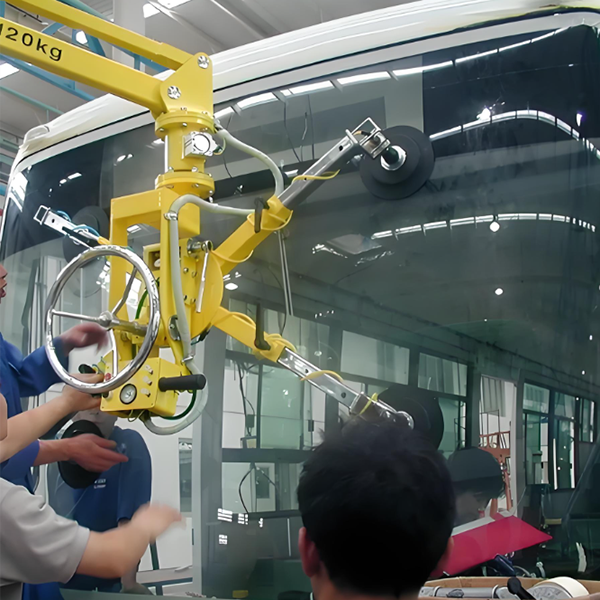
- Vacuum lifting systems: Use suitable suction tools to handle compatible glass panels, sheet materials, and other products with appropriate surfaces.
- Mechanical gripping manipulators: Use customized clamps, jaws, or dedicated fixtures to hold components securely.
- Customized assembly lifting systems: Combine lifting arms, support structures, and application-specific end effectors to meet particular production requirements.
The most suitable configuration depends on the component’s weight, dimensions, center of gravity, surface characteristics, movement requirements, and assembly environment.
Key Applications of Automotive Assembly Lifting Equipment
1. Car Door Installation
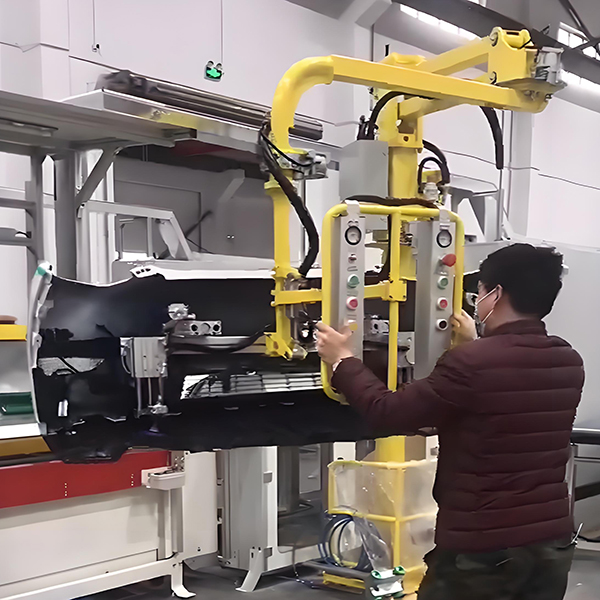
Vehicle doors can be bulky and awkward to handle, particularly when operators must align hinges and mounting points within a limited workspace.
A door handling manipulator equipped with customized clamping tools can support the door during lifting and positioning. The operator can guide the component toward the vehicle body while the manipulator supports its weight.
Potential benefits include reduced manual lifting effort, better handling stability, and a lower risk of accidental contact with painted surfaces.
2. Engine and Powertrain Assembly
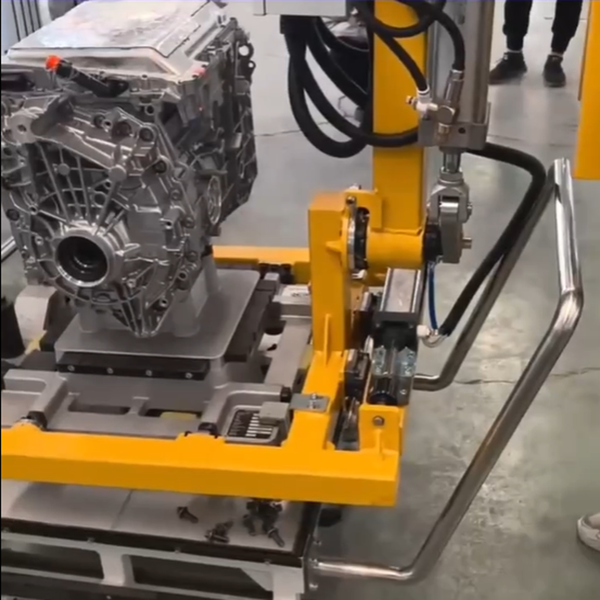
Engines, transmissions, and other powertrain components often require careful positioning during assembly.
A suitable industrial manipulator can lift the component, move it into the required working area, and help maintain its orientation during installation. Customized gripping tools can be designed around the component’s geometry and approved lifting points.
For operations involving tight clearances, stable load control is especially important because the component must be aligned with the mounting structure before fastening.
3. Electric Vehicle Battery Handling
Electric vehicle battery modules and packs introduce additional handling challenges because of their weight, dimensions, and sensitivity to improper contact.
Car assembly lifting equipment can be configured for battery module transfer, subassembly operations, and controlled positioning during vehicle integration. Depending on the load and process, manufacturers may consider pneumatic or electric manipulators, dedicated lifting axes, or other engineered lifting solutions.
Battery handling equipment should be selected according to the actual payload, required positioning accuracy, battery geometry, and applicable safety requirements. Dedicated fixtures and protective contact surfaces can also help reduce the risk of component damage.
4. Dashboard and Cockpit Installation
Dashboards and cockpit assemblies are often large, irregularly shaped components that must pass through restricted openings before reaching their installation positions.
A customized manipulator can support the assembly while allowing the operator to guide its movement and orientation. Suitable tooling and a well-planned working envelope help the component reach the required position with less manual effort.
This approach is particularly useful when assembly workers need to maneuver bulky components around the vehicle body without damaging nearby surfaces or interior parts.
5. Wheel, Tire, and Hub Assembly
Wheels, tires, and hub assemblies can create repetitive lifting demands in automotive production.
A lifting manipulator with a dedicated gripping or expansion mechanism can help operators pick up, rotate, and position these components during assembly. The tooling should be matched to the product’s shape, weight, and gripping requirements.
By supporting the load throughout the operation, the system can make repeated handling more manageable while maintaining operator control.
Benefits of Using Car Assembly Lifting Equipment
Improved Workplace Ergonomics
Repeated manual lifting, awkward reaching, and sustained handling can contribute to worker fatigue and musculoskeletal strain.
Lifting manipulators provide mechanical assistance during demanding operations, helping reduce the physical effort required from operators. The actual ergonomic improvement depends on equipment configuration, task design, and correct use.
More Controlled Component Positioning
Automotive assembly often involves aligning components with fixtures, fasteners, or mounting points. A properly designed manipulator supports the workpiece during movement and positioning.
Rigid-arm structures and application-specific gripping tools can be particularly useful when load swing or uncontrolled movement would make alignment more difficult.
Consistent Production Workflows
Repetitive lifting tasks can become more manageable when operators use equipment designed around a defined handling sequence.
A suitable manipulator can support consistent pickup, transfer, rotation, and placement procedures. This may help reduce handling delays and improve workflow consistency, although overall cycle-time performance depends on the complete production process.
Flexible Integration
Not every automotive assembly operation requires a fully automated robot. Some tasks benefit from human judgment and flexible manual guidance, especially when component variants or assembly conditions change.
Industrial manipulators can provide powered lifting while allowing workers to control the final movement. Depending on the system design, equipment can be floor-mounted, column-mounted, or integrated with an overhead support structure.
How to Choose the Right Car Assembly Lifting Equipment
Selecting appropriate lifting equipment requires more than checking the maximum load capacity. Manufacturers should evaluate the complete handling task before choosing a solution.
1. Load capacity
Determine the maximum workpiece weight, including any gripping tools or fixtures supported by the lifting system. The selected equipment must remain within its rated operating limits.
2. Workpiece geometry
Consider the component’s dimensions, center of gravity, available gripping points, and surface condition. These factors influence the choice of clamps, vacuum pads, or other end effectors.
3. Required movement
Identify whether the component needs vertical lifting, horizontal transfer, rotation, tilting, or precise alignment. The manipulator’s working radius and lifting stroke should match the production layout.
4. Production cycle
Assess the frequency of handling operations and the required movement speed. Repetitive, high-frequency tasks may require a different configuration from occasional heavy-component positioning.
5. Workspace and mounting
Review available floor space, overhead clearance, workstation access, and structural support. The equipment must fit the intended working area without interfering with conveyors, operators, or adjacent machinery.
6. Safety requirements
Consider load retention, emergency stopping, operator controls, maintenance access, and the consequences of power or air-supply failure. The final system should be designed, installed, and operated according to the applicable machinery safety requirements.
Why Choose a Customized Industrial Manipulator?
Automotive assembly lines handle many component types, and a standard lifting device may not suit every task.
A customized industrial manipulator can be designed around the workpiece, workstation, and required handling sequence. Options may include pneumatic balancing, electric lifting, rigid or articulated arms, specialized gripping tools, and tailored mounting structures.
At TL Manipulator, manufacturers can explore industrial handling solutions for automotive assembly and other demanding material handling applications. The automotive assembly manipulator is a relevant starting point for evaluating equipment intended for vehicle component handling.
When planning a customized solution, providing the workpiece drawings or photographs, weight range, required movement, and workstation layout can help equipment engineers assess the application more accurately.
Conclusion
Car assembly lifting equipment plays an important role in modern automotive manufacturing by supporting safer, more controlled, and more ergonomic component handling.
From doors and dashboards to wheels, powertrain components, and EV battery assemblies, the right lifting manipulator can reduce manual handling demands and help operators position workpieces more consistently.
The best solution depends on load capacity, component geometry, handling frequency, workspace constraints, and safety requirements. By matching the lifting mechanism and gripping tools to the actual production task, automotive manufacturers can build a more practical and efficient assembly process.
For companies seeking customized lifting solutions, industrial manipulators offer a flexible approach to improving automotive component handling without requiring every operation to become fully automated.
Post time: Oct-22-2026